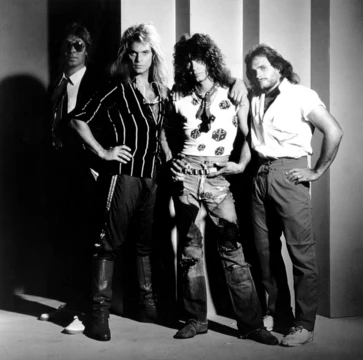
The Right Now Riff
Eight bars of palm-muted fury that hit like a door slamming shut—and made the whole world feel like it was being rewired at once.
In the fan-lore of the Van Halen universe, 'The Right Now Riff' refers to the signature guitar figure that drives the track 'Right Now' from the landmark 1984 album. Rather than a literal object, fans treat this riff as a sonic artifact—a concentrated burst of aggressive, palm-muted energy and open-string stabs that Eddie Van Halen, Michael Anthony, and Sammy Hagar forged into the song's identity. It sits at the heart of the band's mid-1980s sound: hard, propulsive, and unapologetically loud. Within fan mythology, the riff is celebrated as a 'power' in the way a legendary guitar solo or a perfectly tuned amplifier cabinet might be: a thing that, once heard, rewires the listener's sense of what rock music can do in a single eight-bar phrase. It is the sound of the band at the peak of their studio dominance, channeled through Eddie's custom instrument and Hagar's snarling vocal delivery.
Quick Facts
- Song
- Right Now
- Album
- 1984
- Primary writers
- Eddie Van Halen
- Michael Anthony
- Sammy Hagar
- Lead guitar
- Eddie Van Halen (custom 'Frankenstrat')
- Vocals
- Sammy Hagar
- Bass
- Michael Anthony
- Genre
- Hard rock; West Coast rock
Lore & Background
Fans of the Van Halen universe often speak of 'The Right Now Riff' the way a mythic tradition speaks of a forged blade: something made in a single, decisive act and never quite replicated. The riff's architecture—alternating open-string stabs, tight power-chord pulses, and a snarling melodic hook—gave the track its forward lurch. In the 1984 album's running order, it sits among the band's most anthemic compositions, and listeners describe the first few seconds as a physical jolt, as though the speakers themselves were being re-tuned. The 'power' attributed to the riff in fan circles is less supernatural than psychological. Eddie Van Halen's technique on the track—his use of the whammy bar, his aggressive attack, the way he let the strings ring into the next phrase—created a sense of relentless momentum. Combined with Michael Anthony's driving bass line and Sammy Hagar's barked, confrontational vocal phrasing, the riff became a template for an entire generation of hard-rock songwriting in the mid-1980s. In the broader Van Halen fan-lore, the riff is sometimes contrasted with the band's more melodic or experimental moments. Where a track like 'Top of the World' soars, 'Right Now' slams. Fans frame it as the 'ground' to the band's 'sky'—the anchor that keeps the 1984 album from drifting into pure showmanship.
Reader's Guide
In the Van Halen fan-universe, 'The Right Now Riff' is understood as a performance artifact rather than a physical object. Its 'power' is the kinetic energy of a specific guitar figure played with a specific attack, on a specific instrument, in a specific room. To 'wield' it means to reproduce the interplay: Eddie's palm-muted stabs and open-string riffs, Michael's driving eighth-note bass pulse, and Sammy's confrontational vocal phrasing all locking into a single, propulsive groove. The riff 'works' through contrast. The open-string hits create a bright, almost metallic crack against the darker, tighter power chords. The whammy-bar dips add a vocal-like inflection to the guitar line, making the instrument feel like it's arguing with the singer. The tempo is fast enough to feel urgent but steady enough to lock into, giving the listener a groove to ride. Who wields it? In the canonical recording, it is Eddie Van Halen on guitar, Michael Anthony on bass, and Sammy Hagar on vocals, with the rhythm section of the 1984 sessions providing the foundation. In fan practice, any guitarist who can nail the open-string stabs and the whammy-bar phrasing is said to have 'touched the artifact.' The riff is not rare or secret; it is on a record anyone can press play on. Its power lies in the fact that it still hits the same way forty years later.
Did You Know?
- Eddie Van Halen performed the guitar parts on his signature custom 'Frankenstrat,' a guitar he designed and built himself from a $50 body and a maple neck, which became as iconic as the music it produced.
- The 1984 album, which contains 'Right Now,' is widely regarded as one of the defining records of the mid-1980s hard-rock era and helped cement the band's mainstream dominance, spending 80 weeks on the Billboard 200.
More in powers
Elsewhere in Van Halen
Spotted an error? Know more?
Reader corrections go straight into our review queue. Suggest an edit · How this site is sourced