AeroVironment FQM-151 Pointer
A hand-launched surveillance UAV used by US forces from 1990.
Last updated

Museum of Veterinary Anatomy FMVZ USP / Wagner Souza e Silva · CC BY-SA 4.0
The AeroVironment FQM-151 Pointer is a compact, hand-launched drone that the U.S. Army and Marine Corps have used for watching over battlefields. The company behind it, AeroVironment Incorporated, was once headed by Paul MacCready, a designer famous for the human-powered Gossamer Condor and a robotic pterodactyl replica. The Pointer was paid for out of the company’s own pocket, and the U.S. Army and Marine Corps bought roughly 50 of them starting in 1990.
Built mostly from tough Kevlar, the radio-controlled Pointer looked like a hobbyist’s RC sailplane with a small engine tacked on. Its wing sat above the fuselage on a pylon, with a pusher propeller mounted behind that pylon.
A lithium battery pack powered the compact electric motor that spun the propeller. To launch it, a person simply threw it by hand. Recovery was just as simple: the operator put the drone into a flat spin, letting it flutter gently back to the ground.
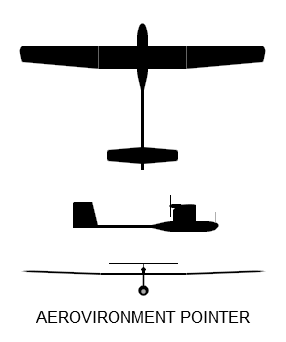
A CCD camera was fixed in the Pointer’s nose, so the drone had to be aimed directly at a target to see it—hence the name “Pointer.” That camera offered a resolution of 360 by 380 pixels and a viewing angle of 22 by 30 degrees. Video could be sent back to the ground station either by radio or through a fiber-optic link. The ground station recorded the footage on an eight-millimeter video cassette recorder, with digital compass directions overlaid on the image.
The controller could also add spoken comments. Playback allowed normal, freeze-frame, fast, or slow-motion viewing. The whole aircraft system and the ground control station each fit into separate backpacks, and the setup required one pilot and one observer.
Over time, the Pointers in U.S. military service received upgrades, including GPS and inertial navigation. The design also spawned several derivatives. The Pointer itself is still in use and saw action during the 2001 intervention in Afghanistan and the 2003 invasion of Iraq.
More in Unmanned Aerial Vehicles by Country
Sources
Compiled from Wikipedia and the sources listed below. Text from Wikipedia is available under CC BY-SA 4.0; this entry is adapted from it.
- Wikipedia: AeroVironment FQM-151 Pointer (CC BY-SA 4.0).
Spotted an error? Know more?
Reader corrections go straight into our review queue. Suggest an edit · How this site is sourced