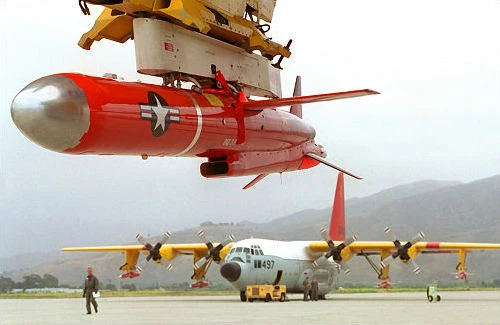
Boeing YQM-94 B-Gull
Developmental high-altitude reconnaissance drone with runway takeoff and landing.
Last updated
The Boeing YQM-94 B-Gull (designated Compass Cope B) was an experimental reconnaissance drone. It could operate from runways like a piloted aircraft, staying aloft for up to 24 hours at high altitude to conduct surveillance, relay communications, or sample the atmosphere.
The Compass Cope program began in 1971 when the U.S. Air Force sought a new drone with runway takeoff and landing, high-altitude endurance, and multi-mission capability. Boeing was initially chosen as the sole contractor and received a contract for two YQM-94A (later YGQM-94A) demonstrators that year. Ryan Aeronautical then proposed an alternative, and in 1972 the Air Force awarded Ryan a contract for two YQM-98A (later YGQM-98A) demonstrators as well.
The YQM-94A was a cantilever shoulder-wing monoplane, essentially a jet-powered sailplane. It had long straight wings, a twin tail, retractable tricycle landing gear, and a turbojet housed in a pod on its back.
The engine was a General Electric YJ97-GE-100 producing 5,270 pounds of thrust. The airframe used aluminum and fiberglass; the lower half of the circular fuselage was glass-fiber honeycomb, the same material used for radomes. The wings were aluminum-skinned honeycomb with a fiberglass core that insulated the fuel tanks from the extreme cold at high altitudes.
As a demonstrator, the YQM-94A used off-the-shelf components to cut costs. Its datalink was based on the AN/TPW-2A X-band radar, and its flight control system came from the Sperry Corporation system used on the Beechcraft QU-22B Pave Eagle.
The drone was controlled remotely from the ground with no autonomous guidance; a nose-mounted television camera let a ground pilot fly it. The landing gear came from a Rockwell Commander. Because the YQM-94’s fuselage sat lower than the Commander’s, Boeing used this as a lift-dumping system: as the aircraft settled onto its strengthened nose wheel, the wing was placed at a negative angle of attack.
The remote control system was tested over ten months using a Cessna 172, chosen because its approach speed and wing loading were similar to the YQM-94’s. By the end of 1971, the system had been tested in 150 flights with eight different remote pilots. Ninety of those flights occurred at night using a low-light television system.
More in Unmanned Aerial Vehicles by Country
Sources
Compiled from Wikipedia and the sources listed below. Text from Wikipedia is available under CC BY-SA 4.0; this entry is adapted from it.
- Wikipedia: Boeing YQM-94 B-Gull (CC BY-SA 4.0).
Spotted an error? Know more?
Reader corrections go straight into our review queue. Suggest an edit · How this site is sourced