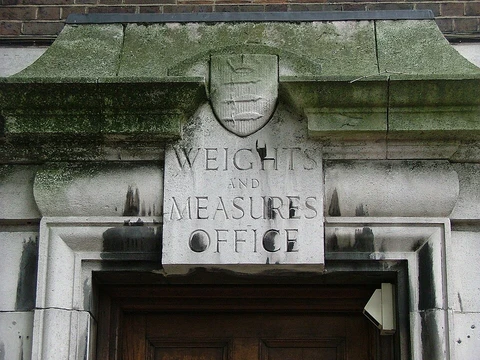
Kilogram

The kilogram (sometimes spelled kilogramme) is the SI base unit of mass, equivalent to 1,000 grams. Its symbol is kg. The name combines the metric prefix *kilo-* (meaning one thousand) with *gram*, and it is often shortened informally to "kilo" (plural "kilos").
As an SI base unit, the kilogram is now defined using three fundamental constants: a specific transition frequency of the caesium-133 atom, the speed of light, and the Planck constant. A metrology lab with proper equipment can use a Kibble balance to calibrate a mass measurement instrument as a primary standard for the kilogram.
Originally defined in 1795 during the French Revolution, the kilogram was the mass of one litre of water (first at 0 °C, later changed to the temperature of maximum density, about 4 °C). The current definition matches that original one to within 30 parts per million (0.003%). In 1799, the platinum Kilogramme des Archives replaced the water-based standard. In 1889, a platinum–iridium cylinder called the International Prototype of the Kilogram (IPK) became the metric system’s mass standard, remaining so for 130 years until the current definition was adopted in 2019.
**Definition**
The kilogram is defined by three constants: the atomic transition frequency ΔνCs (which sets the second), the speed of light *c* (which, with the second, sets the metre), and the Planck constant *h* (which, with the metre and second, sets the kilogram). The formal definition from the General Conference on Weights and Measures (CGPM) states:
The kilogram, symbol kg, is the SI unit of mass. It is defined by taking the fixed numerical value of the Planck constant *h* to be 6.62607015×10⁻³⁴ when expressed in the unit J⋅s, which equals kg⋅m²⋅s⁻¹, where the metre and second are defined in terms of *c* and ΔνCs.
This definition remains consistent with earlier ones: the kilogram is still within 30 parts per million (0.003%) of the mass of one litre of water at its maximum density (about 4 °C), where water’s density is very close to 1 kg/L.
**Timeline of previous definitions**
- 1793: The *grave* (precursor to the kilogram) was defined as the mass of 1 litre (dm³) of water, equal to 18,841 grains. - 1795: The gram (1/1000 of a kilogram) was provisionally defined as the mass of one cubic centimetre of water at the melting point of ice (0 °C). - 1799: The Kilogramme des Archives was made as a prototype, with a mass equal to 1 dm³ of water at its maximum density (about 4 °C). - 1875–1889: The Metre Convention was signed in 1875; the International Prototype of the Kilogram (IPK) was produced in 1879 and adopted in 1889. - 2019: The kilogram was defined in terms of the Planck constant, the speed of light, and the hyperfine transition frequency of ¹³³Cs, as approved by the CGPM on 16 November 2018.
**Name and terminology**
The kilogram is the only SI base unit with an SI prefix (*kilo*) in its name. The word *kilogramme* or *kilogram* comes from the French *kilogramme*, a learned coinage that prefixes the Greek *khilioi* ("a thousand") to *gramma*, a Late Latin term for a small weight (from Greek *grámma*). The word *kilogramme* was written into French law in 1795 in the Decree of 18 Germinal, which revised the provisional system of units introduced two years earlier. In that earlier system, the *gravet* was defined as the weight of a cubic centimetre of water (1/1000 of a *grave*). The 1795 decree replaced *gravet* with *gramme* and *grave* with *kilogramme*.
The French spelling was adopted in Great Britain when the word first appeared in English in 1795, while the spelling *kilogram* was adopted in the United States. In the UK, both spellings are used, though *kilogram* is now far more common; UK trading law does not forbid either. In the 19th century, the French shortening *kilo* entered English, used for both kilogram and kilometre. While *kilo* is acceptable as an alternative (e.g., to *The Economist*), Canada’s Termium Plus system notes that SI usage in scientific and technical writing does not allow it, and Russ Rowlett’s *Dictionary of Units of Measurement* calls it a common informal name. The US Congress legalized the metric system in 1866, permitting *kilo* as an alternative to *kilogram*, but revoked that status in 1990.
The SI system was introduced in 1960, and in 1970 the BIPM began publishing the SI Brochure, which contains all CGPM decisions and recommendations on units. The Brochure states that abbreviations for unit symbols or unit names are not permissible. For use with East Asian character sets, the SI symbol is encoded as a single Unicode character, U+338F ㎏ SQUARE KG, in the CJK Compatibility block.
**Redefinition based on fundamental constants**
The replacement of the International Prototype of the Kilogram (IPK) as the primary standard was driven by long-term evidence that the mass of the IPK and its replicas had been changing; the IPK had diverged from its replicas by about 50 micrograms since they were made in the late 19th century.
- field
- Metrology
- known_for
- Base unit of mass in the International System of Units (SI)
- unit_symbol
- kg
Lore & Background
The kilogram is the base unit of mass in the International System of Units (SI), with the unit symbol kg. Its name combines the metric prefix *kilo-* (meaning one thousand) with *gram*. The kilogram is the only SI base unit whose name includes a prefix. It is defined through three fundamental constants of nature: a specific transition frequency of the caesium-133 atom, the speed of light in a vacuum, and the Planck constant. A properly equipped metrology laboratory can use an instrument like a Kibble balance to calibrate a primary standard for the kilogram mass. Historically, the kilogram was first defined in 1795 during the French Revolution as the mass of one litre of water, initially at 0 °C and later at the temperature of its maximum density (approximately 4 °C). In 1799, a platinum cylinder called the Kilogramme des Archives replaced the water-based standard. This was followed in 1889 by the International Prototype of the Kilogram (IPK), a cylinder of platinum–iridium that served as the standard for 130 years. The current definition, adopted in 2019, agrees with the original water-based definition to within 30 parts per million (0.003%). The kilogram is commonly shortened to "kilo" (plural "kilos"), though formal SI usage does not permit such abbreviations. The word entered English from French in 1795, with the spelling *kilogram* prevailing in the United States and both *kilogram* and *kilogramme* used in the United Kingdom.
Reader's Guide
The kilogram is the sole SI base unit whose name includes a metric prefix, "kilo," meaning one thousand. Its definition has evolved significantly over time. Originally defined in 1795 during the French Revolution as the mass of one litre of water (first at 0 °C, later at the temperature of its maximum density, roughly 4 °C), this original definition agrees with the current one to within 30 parts per million. A platinum prototype, the Kilogramme des Archives, replaced the water-based standard in 1799. In 1889, a platinum–iridium cylinder known as the International Prototype of the Kilogram (IPK) became the standard for the metric system, serving for 130 years. The current definition, adopted in 2019, is based on three defining constants of the International System of Units: a specific transition frequency of the caesium-133 atom, the speed of light in vacuum, and the Planck constant. This shift from a physical artifact to fundamental constants ensures long-term stability and reproducibility. A properly equipped metrology laboratory can use a Kibble balance as a primary standard to calibrate mass measurement instruments for the kilogram. The kilogram is commonly shortened to "kilo" in informal usage, though the SI system does not permit abbreviations for unit symbols or names.
Did You Know?
- The word 'kilogram' is derived from the French 'kilogramme', which combined the Greek stem for 'a thousand' with 'gramma', a Late Latin term for a small weight.
The Call for Coherence
By the mid-1800s, scientists across Europe recognized that the patchwork of measurement systems in use was holding back scientific progress. The demand was clear: a single, coherent framework where every unit flowed directly from a small set of base units, with no arbitrary conversion factors needed. The British Association for the Advancement of Science answered part of that call in 1874 with the CGS system, built on the centimetre, gram, and second. Yet CGS stumbled when it met electromagnetism—the derived electrical units simply did not line up with the practical volt, ampere, and ohm that engineers and telegraph operators relied on daily. The solution took shape after the Metre Convention of 1875, which set in motion the creation of international prototypes for the kilogram and the metre. When the General Conference on Weights and Measures formally sanctioned those prototypes in 1889, the MKS system was officially born, anchoring its base units in the kilogram and the metre rather than their smaller CGS cousins.
Taming Electromagnetism
The MKS system worked beautifully for mechanics and commerce, but it left a glaring gap in the world of electricity. In 1901, Italian physicist Giovanni Giorgi presented a bold idea to the Associazione elettrotecnica italiana: extend MKS with a fourth base unit drawn directly from the practical electrical units already in everyday use—volt, ohm, or ampere. Electrical engineer George A. Campbell became a passionate advocate for this extension, pushing it into wider acceptance. The International Electrotechnical Commission formally adopted Giorgi's proposal in 1935, dubbing it the M.K.S. System of Giorgi, though it stopped short of naming which electrical unit would serve as the fourth base. That decision came in 1939, when the Consultative Committee for Electricity recommended the ampere. The General Conference on Weights and Measures gave its final approval in 1954, and the so-called MKSA system was complete—MKS finally speaking the same language as the electrical engineer's bench.
From MKS to the Modern SI
The MKS system was never meant to be a final destination; it was a stepping stone. In 1960, the kelvin and the candela were added as additional base units, and the resulting framework was christened the International System of Units, or SI, from its French name Système international d'unités. A decade later, in 1971, the mole joined as the seventh base unit, rounding out the set we recognize today. Since then, the SI has undergone several redefinitions, and it now rests entirely on fundamental physical constants rather than physical artefacts. Yet for nearly every practical purpose in engineering, commerce, and everyday measurement, the modern SI still closely mirrors the original MKS values. The kilogram, once tied to a platinum-iridium cylinder in a vault in Sèvres, now derives from constants of nature, but a kilogram of flour on your kitchen scale is still, for all intents and purposes, the same kilogram the 1889 delegates had in mind.
A Coherent Architecture
What makes the MKS framework so elegant is its internal consistency. Distances are expressed in metres, mass in kilograms, and time in seconds, and every other quantity in physics falls out of those three—or four, with the ampere—through simple algebraic combinations. Velocity, for instance, is metres per second. Force, the newton, is defined as kilogram times metres per second squared, a unit that carries its own name because it appears so frequently in mechanics and engineering. This coherence stands in sharp contrast to systems like United States customary units, where converting between inches, feet, yards, and miles requires memorizing a web of factors. The rationalized variant, often called the rmks system, further streamlines electromagnetic equations by absorbing certain geometric factors into the definitions. Whether used in a physics lecture hall or a factory quality-control lab, the MKS architecture lets a scientist move from one domain to another without reaching for a conversion table.
Frequently Asked Questions
Who is Kilogram (Units & Measurement 1-24)?
Kilogram (symbol: kg) is the base unit of mass in the International System of Units, equal to one thousand grams. In everyday conversation it is usually shortened to just "kilo."
What is Kilogram's role in the SI system?
Kilogram anchors the entire mass dimension of the SI, meaning every derived unit involving mass—newtons, pascals, joules—traces back to it. It is one of the seven base units that hold the coherent measurement system together.
Why is Kilogram considered so important to fans of metrology?
Because it is the single SI base unit for mass, every measurement of weight, density, and force in science and engineering ultimately depends on it. A stable, constant-based definition keeps the whole unit system coherent and universal.
More in Units & Measurement 1-24
Spotted an error? Know more?
This is a living reference — every entry is fact-audited, and reader corrections feed straight into our audit queue. Suggest an edit · See this site's audit record