Frequently Asked Questions
The most-asked questions about u.s. states.
What are U.S. states?
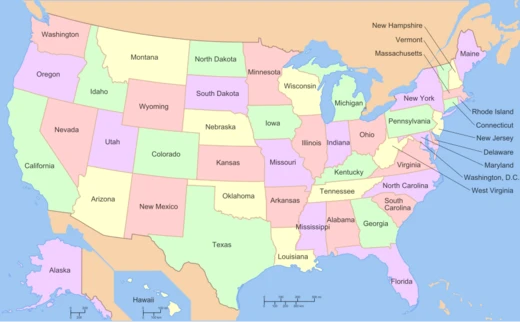
U.S. states are the 50 constituent political entities that make up the United States, each possessing its own constitution, governor, and court system. They operate under a shared federal framework while retaining significant sovereign authority over internal matters.
How many states are in the U.S.?
There are 50 states in total. Alaska and Hawaii were the last to join, both admitted in 1959.
Who are the key historical figures behind the state system?
The constitutional framework balancing state and federal power was drafted in the 1780s by figures including James Madison, Alexander Hamilton, and George Washington. Their work established the principles of federalism that still define state authority today.
Where should a newcomer begin exploring U.S. states?
Start with Article IV of the U.S. Constitution, which outlines interstate relations and the admission of new states. From there, comparing a few states' constitutions and capitals gives a solid foundation before diving into individual state histories.
What are some standout facts about the 50 states collectively?
The states range from Rhode Island's roughly 1,500 square miles to Alaska's more than 580,000, and their populations span from a few hundred thousand to over 39 million. Despite this diversity, every state shares the same constitutional rights and holds exactly two seats in the Senate.
What is one of the most notable moments in statehood history?
The admission of Hawaii as the 50th state on August 21, 1959, finalized the current geographic map of the nation. It ended a decades-long period of territorial growth and marked a symbolic milestone in American expansion.
How do states differ from the federal government in practice?
Each state elects its own governor and legislature and writes its own criminal and civil codes, while the federal government handles defense, currency, and interstate commerce. The Tenth Amendment reserves all powers not explicitly granted to the federal government to the states or the people.
What are state nicknames and symbols?
Every state has an official nickname, such as "The Golden State" for California or "The Palmetto State" for South Carolina. They also designate a state bird, flower, tree, and motto, many of which were adopted in the late 1800s and early 1900s.
In what order were the states admitted?
The first 13 states entered the union at independence in 1776, followed by a steady stream of new admissions through the 19th century. The final two, Alaska and Hawaii, both joined in 1959.
Can a state legally secede from the union?
The Supreme Court held in Texas v. White (1869) that no state may unilaterally withdraw from the union, declaring it perpetual. Debates over the scope of states' rights versus federal authority, however, remain an active part of American political discourse.