Frequently Asked Questions
The most-asked questions about u.s. states and territories.
How many U.S. states and territories are there in total?
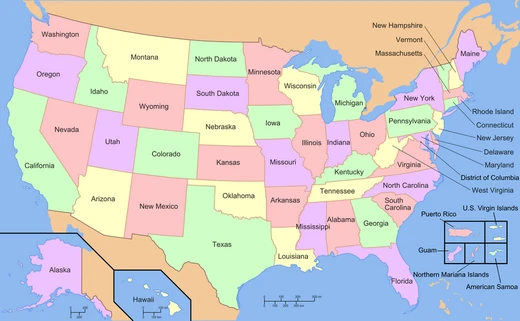
The United States comprises 50 states plus several inhabited territories, the most prominent being Puerto Rico, Guam, the U.S. Virgin Islands, American Samoa, and the Northern Mariana Islands. Together they form the full political map that this encyclopedia covers.
What's the key difference between a state and a territory?
States enjoy full representation in Congress and the right to vote in presidential elections, while territories operate under federal authority with limited or no voting representation in the House and Senate. Territory residents are generally U.S. citizens, with the notable exception of American Samoa, where residents hold U.S. national status.
Who are the 'main figures' in the world of U.S. states and territories?
The primary subjects are the 50 states and the inhabited territories themselves, each carrying its own constitution, governor, and cultural identity. Secondary figures include governors, state legislators, and territorial administrators who shape local policy day to day.
Where should a newcomer start when exploring this topic?
Begin with the 50 states in the order they joined the Union, from Delaware in 1787 through Hawaii in 1959. From there, branch outward into the five inhabited territories and the smaller unorganized outlays in the Pacific and Caribbean.
What are some quick key facts to know about the collection as a whole?
The 50 states cover roughly 3.8 million square miles of land and are home to more than 330 million people. Alaska is the largest state by area while Rhode Island is the smallest, and California holds the single largest state population.
What are some of the most notable moments in the history of U.S. statehood?
The Louisiana Purchase of 1803 roughly doubled the nation's land base and eventually yielded several new states. The admission of Hawaii in 1959 completed the current set of 50, and the ongoing question of statehood for Puerto Rico remains a major political topic.
How did the states get their names?
Most names trace back to Indigenous languages, European monarchs, or geographic features—for example, 'Virginia' honors Queen Elizabeth I's title, while 'Illinois' derives from a Native American term. A handful, such as Massachusetts and Connecticut, come from Algonquian place-names recorded by early colonists.
What rights do territory residents have compared to state residents?
Territory residents generally pay some federal taxes and hold U.S. citizenship (or national status in American Samoa), but they typically cannot vote in presidential elections and lack voting members in Congress. They do, however, elect local governors and legislatures and participate in home-rule governance.
Are there any unorganized or unincorporated territories still under U.S. control?
Yes, the federal government administers small Pacific and Caribbean outlays such as Midway Atoll, Wake Island, and Johnston Atoll, none of which have permanent civilian populations. These are classified as unorganized, unincorporated territories and are managed directly by federal agencies rather than local governments.
What makes this encyclopedia 'unofficial' or fan-made?
It is a community-driven reference written by enthusiasts rather than a government publication, so it aims to be engaging and accessible while still citing verifiable facts. It does not carry the authority of the U.S. Census Bureau or the Office of the U.S. Territories, but it strives for accuracy and clarity throughout.