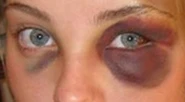
Neurotrauma
Brain cell destruction from trauma or internal causes.
Damage to the brain or spinal cord can result from strokes, infections, tumors, and toxic exposures, as well as from traumatic brain injury (TBI), which is typically caused by external physical trauma to the head.[1][2][3][4][5] Medical management of brain injuries encompasses surgery, medication, physical and occupational therapy, psychotherapy, and measures to prevent additional harm.[6]
Quick Facts
- Synonym
- Brain damage, neurotrauma
- Specialty
- Neurology, Psychiatry
- Symptoms
- Depending on brain area injured
- Types
- Acquired brain injury (ABI)
- traumatic brain injury (TBI)
- focal and diffuse brain injury
- primary and secondary
Facts from the source article.
What the cited sources add
The "What Happens Immediately After the Injury?" account explains that closed head injury damages brain tissue when the brain collides with the skull, bruising tissue and tearing blood vessels.[7] That same source notes that open head injury occurs when the skull is penetrated, for example by a bullet.[7] The Cancer Research UK page on radiotherapy states that radiation can cause changes in brain tissue, with blood vessels slowly becoming scarred and blocked, reducing blood supply to some brain areas.[8] The OncoLink page from Penn Medicine reports that damage to healthy brain tissue from radiation can cause headaches, seizures, or even death.[9]
The DNA Learning Center states that the superior temporal gyrus is the major area involved in the comprehension of language.[10] The "What Happens Immediately After the Injury?" account describes that after a closed head injury, damage can occur both in specific brain areas and throughout the brain due to stretched or destroyed axons.[7]
Key facts and facts and history
Focal brain injuries affect a single area and result from direct force, manifesting as haemorrhages, contusions, and haematomas.[11] Severe focal injuries have a 40% mortality rate, while severe diffuse injuries have a 25% mortality rate.[12] The most prevalent form of brain injury is traumatic brain injury (TBI), which usually results from an external physical force striking the head.[1] To evaluate the severity of a brain injury, clinicians most frequently employ the Glasgow Coma Scale.[13]
On the Glasgow Coma Scale, a score of 3–8 denotes a severe injury, 9–12 a moderate injury, and 13–15 a mild injury.[13] Among traumatic brain injuries, penetrating head trauma is the most deadly; between 70% and 90% of those injured die before they can reach a hospital.[14]
References
- Wikipedia, "Brain injury" (CC BY-SA 4.0), which cites: Ginsburg, "StatPearls", StatPearls Publishing, 2025; "What is an Acquired Brain Injury?", Headway (original not read by us) en.wikipedia.org
- Wikipedia, "Brain injury" (CC BY-SA 4.0), which cites: Unnithan, "Hemorrhagic Stroke", StatPearls, 2025; Lui, "Ischemic Stroke", StatPearls, 2025 (original not read by us) en.wikipedia.org
- Wikipedia, "Brain injury" (CC BY-SA 4.0), which cites: Runde, "Bacterial Meningitis", StatPearls, 2025 (original not read by us) en.wikipedia.org
- Wikipedia, "Brain injury" (CC BY-SA 4.0), which cites: PDQ Adult Treatment Editorial Board, "Adult Central Nervous System Tumors Treatment (PDQ®): Patient Version", PDQ Cancer Information Summaries, 2002; PDQ Adult Treatment Editorial Board, "Adult Central Nervous System Tumors Treatment (PDQ®): Patient Version", PDQ Cancer Information Summaries, 2002; Tanzhu, "Metastatic brain tumors: from development to cutting-edge treatment", MedComm, 2025 (original not read by us) en.wikipedia.org
- Wikipedia, "Brain injury" (CC BY-SA 4.0), which cites: Posin, "Mercury Toxicity", StatPearls, 2025; Methylmercury, "Toxicological Effects of Methylmercury", National Academies Press US, 2000 (original not read by us) en.wikipedia.org
- Wikipedia, "Brain injury" (CC BY-SA 4.0), which cites: Ginsburg, "StatPearls", StatPearls Publishing, 2025 (original not read by us) en.wikipedia.org
- "What Happens Immediately After the Injury?", 2008-07-25. facts only, no text reused. brainline.org
- "Long Term Side Effects of Brain Tumour Radiotherapy", Cancer Research UK, October 22, 2015. facts only, no text reused. cancerresearchuk.org
- "Possible Side Effects of Radiation Treatment for Brain Tumors", Cancer Resources from OncoLink, Penn Medicine, University of Pennsylvania. facts only, no text reused. oncolink.org
- "Superior Temporal Gyrus :: DNA Learning Center", www.dnalc.org. facts only, no text reused. dnalc.org
- Wikipedia, "Brain injury" (CC BY-SA 4.0), which cites: "Neurotrauma: New Insights into Pathology and Treatment", 2007, p. 13–26 (we also read that source) en.wikipedia.org
- Wikipedia, "Brain injury" (CC BY-SA 4.0), which cites: Mckee, "Traumatic Brain Injury, Part I", 2015, p. 45–66; "Neurotrauma: New Insights into Pathology and Treatment", 2007, p. 13–26 (we also read that source) en.wikipedia.org
- Wikipedia, "Brain injury" (CC BY-SA 4.0), which cites: "What Is the Glasgow Coma Scale?" (original not read by us) en.wikipedia.org
- Wikipedia, "Brain injury" (CC BY-SA 4.0), which cites: Alao, "Penetrating Head Trauma", StatPearls, 2025 (original not read by us) en.wikipedia.org
Each numbered sentence above was checked against the source it cites before publication. Sentences citing Wikipedia adapt text from the English Wikipedia article Brain injury (contributors), used under CC BY-SA 4.0; this entry is available under the same licence. Other sources were used for facts only; no text or images are copied from them.
More in Types of Trauma
Spotted an error? Know more?
Reader corrections go straight into our review queue. Suggest an edit · How this site is sourced