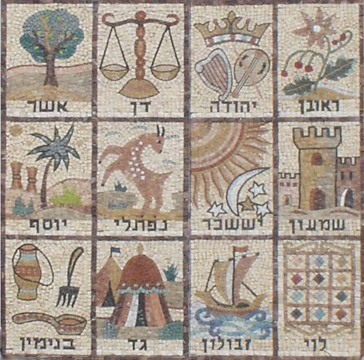
Tribe of Naphtali
Northern tribe known for its fertile land and military valor.
The Tribe of Naphtali was one of the northernmost of the twelve tribes of Israel. Its territory included the eastern side of the Galilee, encompassing the Lower and Upper Galilee, and bordered the Sea of Galilee. The region's prosperity is reflected in the Blessing of Moses, though textual scholars view this as a postdiction.
Quick Facts
- Significant city
- Hazor
- Symbol
- Gazelle
- Date of conquest allocation
- Slightly after 1200 BCE (per Kenneth Kitchen)
- Date of assyrian conquest
- c. 732 BCE
Facts from the source article.
Did You Know?
- According to the Torah, the tribe consisted of descendants of Naphtali, a son of Jacob and Bilhah.
- Arthur Peake viewed the tribal origin as an eponymous metaphor providing an aetiology of connectedness.
Biblical narratives
Following the conquest of Canaan, Joshua allocated land to the tribes, with Naphtali settling the eastern side of the Galilee, in areas now known as the Lower and Upper Galilee. The territory was bordered on the west by Asher, on the north by Dan, on the south by Zebulun, and on the east by the Jordan River. The most significant city was Hazor. Bordering the Sea of Galilee was the highly fertile plain of Gennesaret, described by Josephus as an earthly paradise. The southern portion of the region served as a natural pass between the highlands of Canaan, and major roads from Damascus to Tyre and Acre ran through it. The prosperity this brought is seemingly prophesied in the Blessing of Moses, though textual scholars view this as a postdiction, dating the poem to well after the tribe was established. The Naphthalites received the eastern parts as far as Damascus and the Upper Galilee, unto mount Libanus and the Fountains of Jordan. From after the conquest until the formation of the first Kingdom of Israel around 1050 BC, Naphtali was part of a loose confederation of Israelite tribes led by ad hoc leaders known as Judges. With the threat from Philistine incursions, the tribes formed a centralised monarchy, and Naphtali joined the kingdom with Saul as first king. On the accession of Rehoboam around 930 BC, the northern tribes split from the House of David to reform the Northern Kingdom.
Character
The tribe of Naphtali has a strong military tradition. In the ancient Song of Deborah, Naphtali and Zebulun are praised for risking their lives against Sisera; a later prose account adds that Barak, the commander opposing Sisera, came from this tribe. In the Gideon story, Naphtali joins the fight against Midianite raiders, though scholar Arthur Peake believed this narrative was compiled from earlier sources, with the oldest version describing only Gideon and 300 of his own clansmen seeking revenge. The Blessing of Jacob, dated to around 700–600 BC, compares Naphtali to a released doe and praises it for speaking fine words. The tribe’s allotted land was in the far north of Canaan, bordered by the Litani River, the Jordan River, and the tribes of Asher, Zebulun, and Issachar. Its symbol is a gazelle, and its people are traditionally seen as swift runners.
Fate
The tribe of Naphtali was part of the Kingdom of Israel when it suffered devastation at the hands of Ben-Hadad, king of Aram-Damascus, acting for Asa of Judah during his conflict with Baasha. Later, under King Pekah, Naphtali was one of the first tribes to be crushed by Assyria and see many of its people taken captive. The prophet Isaiah later pointed to this same region as the place where the Messianic deliverance would begin. Around 732 BCE, Tiglath-Pileser III conquered Naphtali’s territory and deported the entire population, causing the tribe’s history to vanish. Near Kedesh-naphtali around 150 BCE, Jonathan defeated Demetrius, king of Syria, in a notable battle of the Maccabean war.
Descendants
Beginning in the 19th century, biblical scholarship has largely doubted the historicity of the twelve tribes, including the lost tribes.
More in Twelve Tribes of Israel
Spotted an error? Know more?
Reader corrections go straight into our review queue. Suggest an edit · How this site is sourced