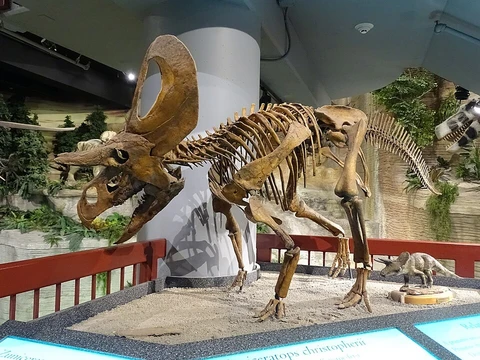
Jeyawati
A basal hadrosauroid dinosaur from the Turonian of New Mexico.
Last updated
Jeyawati is a genus of hadrosauroid dinosaur from the Turonian stage of the Late Cretaceous. Its name, meaning 'grinding mouth' in the Zuni language, refers to its chewing adaptations. The type species, J. rugoculus, was described in 2010 based on fossils from the Moreno Hill Formation in New Mexico.
Scientific classification
- KingdomAnimalia
- PhylumChordata
- ClassReptilia
- CladeDinosauria
- Clade†Ornithischia
- Clade
- Genus†Jeyawati
Named by McDonald, Wolfe & Kirkland, 2010
Sources: Wikipedia taxobox: Jeyawati (CC BY-SA 4.0)
Quick Facts
- Type species
- Jeyawati rugoculus
Facts from the source article.
Discovery
A partial skull and some other bones of a dinosaur were found in 1996 in western New Mexico's Moreno Hill Formation. The discovery was made by paleontologist Douglas G. Wolfe, his wife Hazel, and their son Christopher while working on the Zuni Basin Paleontological Project. Digging and collecting the fossils took about 13 years, with help from James I. Kirkland and volunteers from the Southwest Paleontological Society.
The specimen went to the Arizona Museum of Natural History. Andrew T. McDonald later studied the material as a student and realized it was a new species. In 2010, McDonald, Wolfe, and Kirkland officially named it Jeyawati rugoculus in a scientific journal.
Description
Jeyawati is a dinosaur known only from a partial, scattered skeleton, including skull bones and some body fragments. The single specimen, a subadult or adult, is identified by a rough, wrinkled texture on the side of the postorbital bone, a large opening for nerves and blood vessels at the base of the postorbital's jugal process, and a unique set of other features. Preserved skull parts include sections of the premaxilla, maxilla, prefrontal, postfrontal, quadrate, predentary, and dentary.
Its teeth and jaws show primitive traits, yet it also has characteristics of the hadrosauroid group. Its name means "grinding mouth, wrinkle eye," referencing its chewing adaptations and the textured bone around the eye. In its family tree, Jeyawati sits among early hadrosauroids, more advanced than Probactrosaurus, Eolambia, and Protohadros, but more primitive than Shuangmiaosaurus, Bactrosaurus, and Telmatosaurus.
More in Turonian Dinosaurs
Sources
Compiled from Wikipedia and the sources listed below. Text from Wikipedia is available under CC BY-SA 4.0; this entry is adapted from it.
- Wikipedia: Jeyawati (CC BY-SA 4.0).
- Word definitions: the , each quoted from its Wikipedia article.
Spotted an error? Know more?
Reader corrections go straight into our review queue. Suggest an edit · How this site is sourced