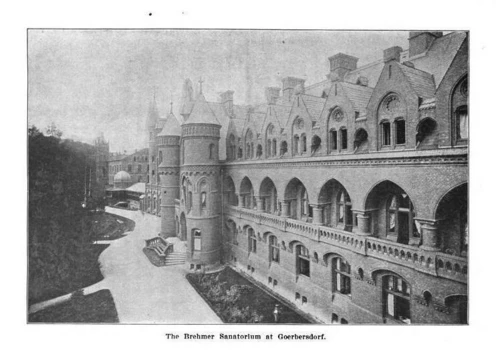
Lesnoye Sanatorium
Last updated

via Wikipedia: Lesnoye Sanatorium · see source
Where it is
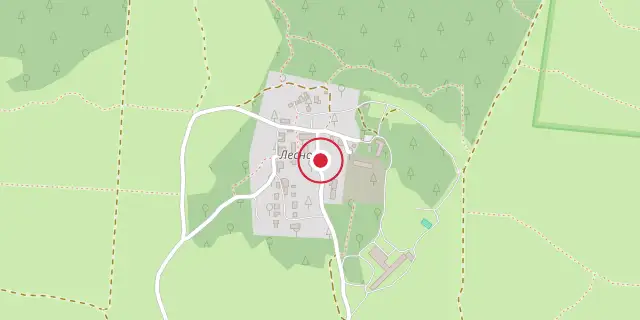
Coordinates: 53°30′04″N 49°21′22″E (53.5010, 49.3560) · Open in OpenStreetMap
Coordinates and connected clubs: the infobox of Wikipedia: Lesnoye Sanatorium (CC BY-SA 4.0). Map: drawn by Codexery from OpenStreetMap tiles.
Lesnoye Sanatorium (санаторий Лесное) is the oldest medical institution in the city of Tolyatti, Russia. Its main focus is tuberculosis treatment. Despite being only 3 km from the center of what is now the large city of Tolyatti, the sanatorium is located in 42 ha of forest (the Tolyatti Pine Forest) near the shores of the Volga, hence its name, which means "Sanatorium in the Forest."
History
Lesnoye Sanatorium was established in 1910 by Stavropol-on-Volga merchant V. N. Klimushin. The original building was a two-storey brick and timber structure with stove heating. Newspaper announcements at its opening highlighted medicinal kumis as part of the therapy. Tuberculosis specialist Vladimir B. Zolotnitsky became the first chief physician, and the first patients were admitted soon after.
The sanatorium employed advanced methods for the era, including the Mantoux test and electrification, and had laboratories and a sunroom. A farm on the steppe kept two hundred horses to supply mare's milk for kumis production; during the holiday season up to 45,000 bottles were made, some sold externally. Patients, mostly wealthy, came from across Russia, with a season costing 200 silver rubles, and the resort attracted aristocrats from Turkey and France.
It featured flower gardens, sculptures, fountains, gazebos, electric lights, water from an artesian well, and horse-drawn carriages for hire. In 1913, French communist Inessa Armand was treated there; a memorial plaque placed in 1967 was later lost during renovation. During World War I, the sanatorium served as a rehabilitation hospital for wounded soldiers and officers. Nationalized in 1918, it came under the Stavropol-on-Volga district health department.
In the 1920s and 1930s, amid widespread tuberculosis outbreaks, it became the base for supervising Moscow tuberculosis clinics and operated at full capacity, with surgical methods and more effective kumis use developed there. During World War II, the Military Institute of Foreign Languages relocated to Stavropol-on-Volga, and a training center for military translators was established at Lesnoye Sanatorium under Lieutenant General Nikolai Biasi. From 1941 to 1942, two thousand translators were trained, including cadets who later became well-known writers, artists, and composers such as Vladimir Etush, Andrei Eshpai, S. Lvov, E. Rzhevskaya, and A. Troyanovsky.
Did You Know?
- A 3-meter statue of Lenin was moved from the grounds to Central Park in 1980 for greater public visibility.
- The sanatorium's kumis is now made from cow's milk, not mare's milk, and is considered slightly inferior in medicinal properties.
- A forest fire in July 2021 broke out near the sanatorium, following another major fire in 2010 that forced a closure from 30 July to 10 December.
More in Tuberculosis Sanatoria
Sources
Compiled from Wikipedia and the sources listed below. Text from Wikipedia is available under CC BY-SA 4.0; this entry is adapted from it.
- Wikipedia: Lesnoye Sanatorium (CC BY-SA 4.0).
Spotted an error? Know more?
Reader corrections go straight into our review queue. Suggest an edit · How this site is sourced