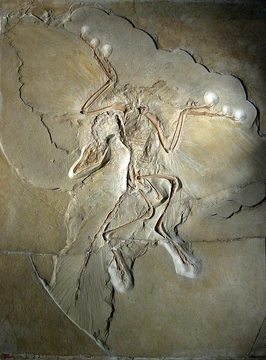
Transitional fossil
Fossils showing traits of both ancestral and descendant groups.
Fossilized remains that combine characteristics of an ancestral lineage and its later, derived form are termed transitional fossils.[1] These specimens highlight that the categories we use in taxonomy are human-made and applied after the fact to a continuous spectrum of change.[1] The fossil record's gaps usually prevent us from determining the precise proximity of a transitional fossil to the actual branching event.[1]
Quick Facts
- Age of archaeopteryx
- Late Jurassic, about 150 million years ago
- Length of archaeopteryx
- about 0.5 metres (1.6 ft)
- Rhynia discovered by
- Robert Kidston and William Henry Lang in 1917
Facts from the source article.
Key facts and history
The term "missing link" was first used in a scientific context by Charles Lyell in 1851.[2] Lyell's vivid writing fired the public imagination, inspiring works such as Jules Verne's Journey to the Center of the Earth.[2] While "missing link" remains a popular term, it is avoided in scientific publications because the links are no longer "missing".[3] Darwin called the apparent absence of transitional forms "the most obvious and gravest objection which can be urged against my theory," attributing it to the geological record's extreme imperfection.[4]
In 1861, two years after Darwin's book, the discovery of Archaeopteryx provided a classic example of a form intermediate between earlier non-avian dinosaurs and birds.[4] Subsequent discoveries have yielded numerous transitional fossils, offering extensive evidence for the relationships among all vertebrate classes.[5] Eugène Dubois's 1891 find on Java—a skullcap, a molar, and a femur—was the first successful discovery of a fossil showing transitional traits between apes and humans.[1] That specimen, designated Pithecanthropus erectus, initiated a long series of fossils documenting human evolution.[1]
What the cited sources add
The TalkOrigins Archive states that a transitional fossil shows a mosaic of features from an older and more recent organism.[6] The same source notes that there are many fossils of human ancestors, and the differences between species are so gradual that it is not always clear where to draw the lines between them.[6] The TalkOrigins Archive also describes a gradual transitional fossil sequence connecting the foraminifera Globigerinoides trilobus and Orbulina universa.[6] The same account states that the species was formally named in 1978 following fossil discoveries at those sites.[7]
The Science Daily article reports that Dr. Thewissen and colleagues discovered the skeleton of Indohyus as the closest known fossil relative of whales.[8]
References
- Wikipedia, "Transitional fossil" (CC BY-SA 4.0) en.wikipedia.org
- Wikipedia, "Transitional fossil" (CC BY-SA 4.0), which cites: Bynum, "Charles Lyell's Antiquity of Man and its critics", Journal of the History of Biology, Summer 1984, p. 153–187; Browne 2003, p. 130, 218, 515 (original not read by us) en.wikipedia.org
- Wikipedia, "Transitional fossil" (CC BY-SA 4.0), which cites: Zimmer, "Darwinius: It delivers a pizza, and it lengthens, and it strengthens, and it finds that slipper that's been at large under the chaise lounge [sic] for several weeks...", The Loom, 19 May 2009; Prothero, "Evolution: What missing link?", New Scientist, 1 March 2008, p. 35–41; Sambrani, "Why the term 'missing links' is inappropriate", Biology Times, 10 June 2009; Prothero, "Evolution: What missing link?", New Scientist, 1 March 2008, p. 35–41; "Newly found fossils could link to human ancestor", CBC News, 8 April 2010 (original en.wikipedia.org
- Wikipedia, "Transitional fossil" (CC BY-SA 4.0), which cites: ; (original not read by us) en.wikipedia.org
- Wikipedia, "Transitional fossil" (CC BY-SA 4.0), which cites: Prothero, "Evolution: What missing link?", New Scientist, 1 March 2008, p. 35–41 (original not read by us) en.wikipedia.org
- "Claim CC200: Transitional fossils", TalkOrigins Archive, 5 November 2006. facts only, no text reused. talkorigins.org
- "Australopithecus afarensis", Human Evolution. facts only, no text reused. humanorigins.si.edu
- Northeastern Ohio Universities Colleges of Medicine and Pharmacy, "Whales Descended From Tiny Deer-like Ancestors", Science Daily, 21 December 2007. facts only, no text reused. sciencedaily.com
Each numbered sentence above was checked against the source it cites before publication. Sentences citing Wikipedia adapt text from the English Wikipedia article Transitional fossil (contributors), used under CC BY-SA 4.0; this entry is available under the same licence. Other sources were used for facts only; no text or images are copied from them.
More in Transitional Fossils
Spotted an error? Know more?
Reader corrections go straight into our review queue. Suggest an edit · How this site is sourced