Frequently Asked Questions
The most-asked questions about transiting exoplanets, part 2.
What does 'Transiting Exoplanets, Part 2' actually cover?
It is the second volume of this fan encyclopedia, picking up where Part 1 left off by diving into atmospheric characterization, multi-planet transit systems, and the specific missions and discoveries that expanded the catalog beyond the first few hot Jupiters.
Who are the key figures a reader should know in this volume?
The most-cited names are the teams behind HD 209458 b's first transit detection (1999), the Kepler mission's principal investigators who revealed thousands of new worlds, and the TESS program architects who extended transit surveys to the brightest nearby stars.
Where should a complete newcomer begin reading Part 2?
Start with the 'Reading a Transit Light Curve' chapter to build intuition for the U-shaped dip, then move to the Kepler and TESS mission overviews before tackling the atmospheric-spectroscopy sections.
What exactly is the transit method in one sentence?
A planet crosses the face of its host star from our vantage point, briefly dimming the starlight by a tiny, periodic fraction that reveals the planet's size and orbital period.
Which single planet gets the most fan attention in Part 2?
HD 209458 b, nicknamed Osiris, holds the record as the first exoplanet found by transit and the first whose atmosphere (sodium, water vapor, and later carbon monoxide) was spectroscopically identified.
What space missions are central to the Part 2 narrative?
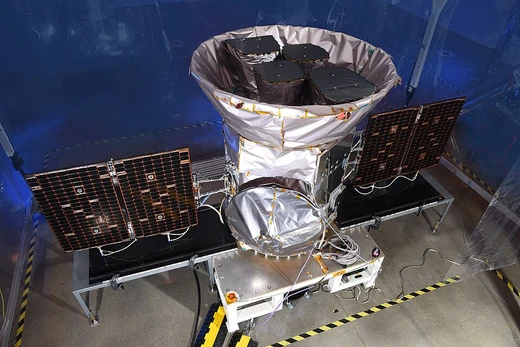
Kepler and its K2 follow-on provided the bulk of the statistical sample, TESS broadened the survey to bright, nearby targets, and the upcoming ESA PLATO mission is expected to refine radii and masses for hundreds of additional systems.
Why do 'hot Jupiters' dominate the transit catalog?
Their large radii produce the deepest, easiest-to-detect dips, and their close orbits mean transits repeat every few days, so they were the first class of planets confirmed and remain the richest targets for atmospheric work.
What is a transit light curve and why does its shape matter?
It is a plot of stellar flux versus time showing a symmetric dip whose depth encodes the planet-to-star radius ratio, whose duration encodes orbital period and stellar density, and whose ingress/egress shape can reveal stellar spots or limb darkening.
What geometric condition must be met for a transit to be visible?
The planet's orbital plane has to be tilted within roughly one degree of perfectly edge-on relative to our line of sight; otherwise the planet passes above or below the stellar disk and no dip is recorded.
What is a standout milestone highlighted in Part 2?
The 2001 detection of sodium absorption in HD 209458 b's atmosphere is often called the 'Rosetta Stone' moment, because it proved that exoplanet atmospheres could be read directly and launched the entire field of transmission spectroscopy.