Frequently Asked Questions
The most-asked questions about trans-neptunian objects, part 3.
What does Part 3 of the TNO encyclopedia cover?
Part 3 focuses on the deeper population of trans-neptunian objects beyond the major dwarfs, including classical Kuiper belt objects, scattered-disc bodies, and extreme outliers like Sedna. It also traces the discovery timeline and the orbital classifications that organize these distant worlds.
Who are the principal figures most associated with TNO discoveries?
Mike Brown, Jane Luu, and David Jewitt are the names fans most often search for, as their teams at Caltech and the University of Hawaii identified Pluto, Eris, Haumea, and Makemake in the late 1990s and 2000s. Their work reshaped the outer solar system and triggered the 2006 IAU reclassification debate.
Where should a newcomer begin reading Part 3?
Start with the Classical Kuiper Belt Objects section, since cubewanos make up the bulk of the TNO population and provide context for the more exotic bodies discussed later. From there, the Plutino and resonant-object entries build naturally toward the scattered-disc and detached-object chapters.
What exactly are cubewanos and why do they have that name?
Cubewanos are classical Kuiper belt objects whose orbits are not locked in a resonance with Neptune and whose perihelia stay well above Neptune's orbit. The nickname comes from the designation 1992 QB1, the first classical KBO ever found, and the term stuck as a shorthand for the entire non-resonant population.
Why is Sedna considered one of the most intriguing TNOs?
Sedna's perihelion sits at roughly 76 AU, far beyond Neptune's gravitational reach, which means no known planet has shaped its orbit over solar-system history. Its 2004 discovery fueled ongoing speculation about a hypothetical distant Planet Nine or an unknown galactic perturbation that could explain its extreme trajectory.
What happened during the New Horizons encounter with Arrokoth in 2019?
NASA's New Horizons spacecraft flew past 2014 MU69 (Arrokoth) on January 1, 2019, making it the most distant object ever visited by a spacecraft. The two-lobed contact-binary morphology gave scientists their first close-up look at a pristine Kuiper belt building block.
What distinguishes Plutinos from other resonant TNOs?
Plutinos share a 3:2 mean-motion resonance with Neptune, completing two orbits for every three Neptune orbits, which keeps them safely away from close encounters. They are the largest known resonant group and include Pluto itself, making the category both dynamically important and personally familiar to fans.
How did the discovery of Eris change the way we classify dwarf planets?
Eris, found in 2005, is slightly more massive than Pluto, which forced the IAU to hold a 2006 vote that created the formal dwarf-planet category. The reclassification demoted Pluto from the ninth planet and placed it alongside Ceres, Eris, Haumea, and Makemake as recognized dwarf planets.
What is the scattered disc and how does it differ from the classical Kuiper belt?
The scattered disc is a sparser population of objects whose highly elliptical, inclined orbits were likely sculpted by past gravitational interactions with the giant planets. Unlike the relatively flat, circular orbits of classical KBOs, scattered-disc members can plunge well inside Neptune's orbit at perihelion while still extending far beyond it at aphelion.
What are some of the most-searched individual TNOs in Part 3?
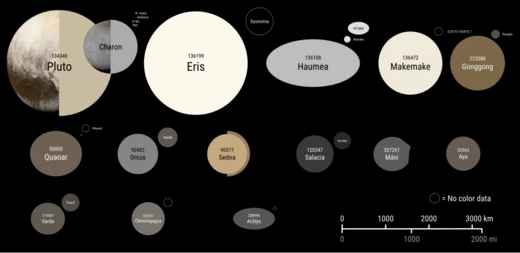
Fans most frequently look up 2007 OR10, Quaoar, Orcus, and Gonggong, all of which occupy the size range just below the confirmed dwarf planets. Their entries typically include orbital elements, albedo estimates, and the small moons that help constrain their masses and densities.