Frequently Asked Questions
The most-asked questions about trans-neptunian objects, part 2.
What is this encyclopedia (part 2) about?
It is a fan-written reference guide to trans-neptunian objects, the icy bodies orbiting beyond Neptune, with part 2 focusing on deeper classification schemes, individual object profiles, and the ongoing cultural debate over what counts as a planet.
Who are the 'main characters' in TNO lore?
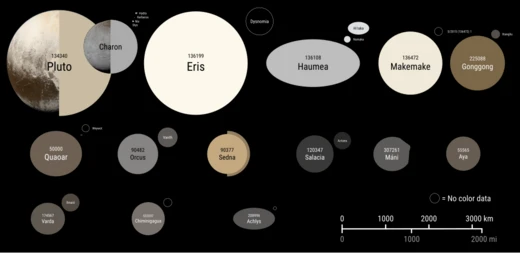
Pluto remains the most iconic figure, but Eris, Sedna, Haumea, and Makemake are the other major names fans track, each distinguished by unique orbital quirks, size controversies, or dramatic discovery stories.
Where should a newcomer start reading part 2?
Begin with the taxonomy overview—cubewanos, plutinos, scattered-disc objects, and detached objects—before diving into individual entries, because the classification framework gives context to every object profile that follows.
What's the difference between the Kuiper Belt and the Scattered Disc?
The Kuiper Belt is a relatively flat, orderly band of icy bodies spanning roughly 30 to 50 AU from the Sun, while the Scattered Disc holds objects whose orbits have been gravitationally stretched into more elongated and tilted paths, often reaching far beyond the Belt's outer edge.
Why is Eris such a flashpoint in TNO fandom?
Its 2005 discovery briefly made it the largest known body beyond Neptune, which directly triggered the 2006 IAU redefinition of 'planet' and permanently split the community into pro- and anti-Pluto camps that still argue in every thread.
What makes Sedna stand out from other TNOs?
Its perihelion sits near 76 AU—well beyond Neptune's gravitational reach—and its aphelion stretches toward 500 AU, making it one of the most distant known solar-system bodies and a prime candidate for a 'detached' or inner-Oort-cloud population.
How are TNOs actually studied if they're so far away?
Astronomers rely on large ground-based telescopes for optical and infrared photometry, rare stellar-occultation events to probe possible atmospheres, and the 2015 New Horizons flyby of Pluto as the only close-range data point we have so far.
What is a 'plutino' and why does the label matter?
A plutino is a TNO locked in a 2:3 mean-motion resonance with Neptune, completing two orbits for every three of Neptune's, and the term lets fans and researchers instantly identify an entire orbital family sharing that rhythm.
Are there confirmed moons around TNOs besides Pluto's Charon?
Yes—Eris has Dysnomia, Haumea has two small moons (Hiʻiaka and Namaka), Makemake has an irregular satellite, and numerous binary TNO pairs have been catalogued, making multi-body systems a common feature of the outer solar system.
What is the biggest open question TNO fans argue about?
Whether a hypothetical 'Planet Nine' or other massive unseen body is perturbing the clustered perihelia of distant detached objects, since known planets alone do not yet explain that orbital alignment.