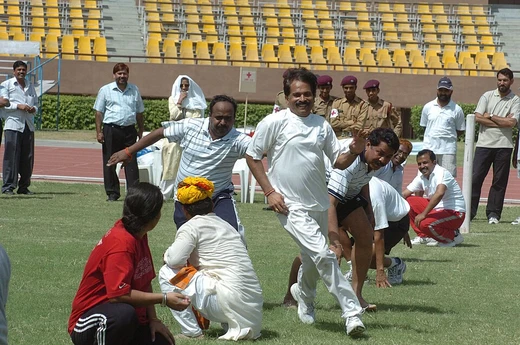
Traditional games in the Philippines
Traditional Filipino games are played outdoors with native materials.
Games that have been handed down across many generations in the Philippines, often crafted from indigenous resources, constitute a wide-ranging collection of traditional pastimes.[1] The phrase "Laro ng Lahi" was created and spread by the Samahang Makasining (Artist Club), Inc., working together with the National Commission for Culture and the Arts.[2][3]
Quick Facts
- Number of games
- more than thirty-eight
- Term coined by
- Samahang Makasining (Makasining)
- Collaborating organizations
- National Commission for Culture and the Arts, local government units
- Modern yo-yo introduced by
- Pedro Flores
- Language of yo-yo name
- Ilocano
Facts from the source article.
Making and release
In 2001, Samahang Makasining proposed a "Laro ng Lahi" project to the National Commission for Culture and the Arts to support actual playing of selected Filipino games.[3] Banaag is an appointed member of the Ad hoc Advisory Committee Traditional Sports and Games, UNESCO.[4] Passing on knowledge of these traditional games to the youth is a primary goal of the Samahang Makasining organization.[5][3] Colorful threads, often from plastic straws, are attached to a washer to create the object used in playing sipa.[6]
A lead washer covered in cloth or plastic, or a rattan ball, can serve as an alternative for playing sipa.[6] To keep the sipa from hitting the ground, a player must strike it repeatedly using their foot or the area just above the knee.[6] Hari Osias Banaag, who founded the Global Sikaran Federation, received a warm welcome at a UNESCO Collective Consultation Meeting focused on Traditional Sports and Games.[4]
What the cited sources add
The Samahang Makasining project list includes games such as Taguan Pong, Piko, Tansing, Putupong, Sundutan sa puno, Siring bulding, Lupa't langit, Tumbang preso, Harantaga o Patintero, Harantagang bilog, Siyatong, Taguang buwan, Tsektsok, Usa-Usa ng Pantabangan, Sigay ng Pantabangan, Holen Butas, Lusalos, Dama, Dampa, Sungka, and Game of the General.[3] In sambunot, a circle is drawn on the floor and a coconut husk is placed at the center.[7] Players rush to get the coconut husk at the signal of "go" and may steal it from another player to win.[7] The names bikabix, kiki, or vicks-vicks are used for piko in Cebu and some Visayan-speaking areas.[8]
Buan-buan is another name for piko in certain parts of Mindanao and the Visayas.[8]
References
- Wikipedia, "Traditional games in the Philippines" (CC BY-SA 4.0), which cites: "Promoting physics in action thru "Laro Ng Lahi-Based" physics activities", Faculty of Science, Technology and Mathematics, Philippine Normal University, Philippines., 2015; "Designing Validated Laro ng Lahi Based Activities in Mechanics", DLSU Research Congress 2015, 2015; Mga Larong Pilipino [Philippine Games]. (2009). Tagalog at NIU. Retrieved December 19, 2009 from the Northern Illinois University, Center for Southeast Asian St (original not read by us) en.wikipedia.org
- Wikipedia, "Traditional games in the Philippines" (CC BY-SA 4.0), which cites: "LARO NG LAHI (Filipino Indigenous Games) Project", Makasining & NCCA, 2001; "(Laro ng Lahi) ABS-CBN Ruffa and Ai", ABS-CBN Ruffa and Ai, 2009}}{{cbignore (we also read that source) en.wikipedia.org
- "LARO NG LAHI (Filipino Indigenous Games) Project", Makasining & NCCA, 2001. facts only, no text reused. makasining.org
- Wikipedia, "Traditional games in the Philippines" (CC BY-SA 4.0), which cites: (TSG) (original not read by us) en.wikipedia.org
- Wikipedia, "Traditional games in the Philippines" (CC BY-SA 4.0), which cites: "Lovely day Laro ng Lahi", GMA 7 Lovely day, 2012}}{{cbignore; "Laro ng Lahi", Samahang Makasining (Artist Club), Inc., 2001 (original not read by us) en.wikipedia.org
- Wikipedia, "Traditional games in the Philippines" (CC BY-SA 4.0), which cites: "Alive and Kicking No More: What Ever Happened to Sipa", MANIFESTO, August 7, 2014 (original not read by us) en.wikipedia.org
- Wikipedia, "Traditional games in the Philippines" (CC BY-SA 4.0), which cites: Lopez, "A study of Philippine games", University of the Philippines Press, 1980, p. 146–148 (original not read by us) en.wikipedia.org
- Wikipedia, "Traditional games in the Philippines" (CC BY-SA 4.0), which cites: Alfarero, J. and Mejarito, C.L. (no date) (PDF) Traditional Games in Leyte and the values learned by the players, ResearchGate. Available at: https://www.resear (original not read by us) en.wikipedia.org
Each numbered sentence above was checked against the source it cites before publication. Sentences citing Wikipedia adapt text from the English Wikipedia article Traditional games in the Philippines (contributors), used under CC BY-SA 4.0; this entry is available under the same licence. Other sources were used for facts only; no text or images are copied from them.
More in Traditional Games
Spotted an error? Know more?
Reader corrections go straight into our review queue. Suggest an edit · How this site is sourced