Kyoto City Zoo
Last updated

via Wikipedia: Kyoto City Zoo · see source
Where it is
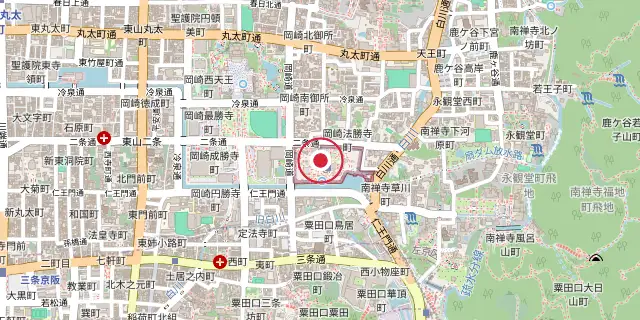
Coordinates: 35°00′47″N 135°47′10″E (35.0130, 135.7860) · Open in OpenStreetMap
Coordinates and connected clubs: the infobox of Wikipedia: Kyoto City Zoo (CC BY-SA 4.0). Map: drawn by Codexery from OpenStreetMap tiles.
Kyoto City Zoo (京都市動物園) is a zoo in Sakyō ward, Kyoto. Established in 1903, it is the second oldest zoo in Japan after Ueno Zoo in Tokyo. The zoo is a member of the World Association of Zoos and Aquariums.
History
The zoo opened on 1 April 1903 with 238 animals representing 61 species across 3.4 ha, drawing 6,591 visitors on its first day. A guide was first published in 1905, and by its tenth year the zoo housed 274 individuals of 156 species. The Elephant Room opened in 1923, allowing elephants to move from temporary to permanent quarters, and the Hippopotamus Room followed in 1927. By 1940 the population had grown to 965 individuals of 209 species.
The southern part of the zoo was taken over by occupation forces, which left in 1952. The Giraffe Room and a saltwater aquarium opened in 1953 (the aquarium was removed in 1968), and the Sea Lion Pond was completed in 1954. That year the zoo held its first Summer School with 180 students. Fairyland, an amusement park with a Ferris wheel, fun train, and dodgem cars shaped like cartoon and film characters, opened in 1955.
The Ape Room was built in 1969, the Reptile Room in 1974, and the Red Panda Room in 1980. The dome aviary (Water Bird Pavilion), 21 m in diameter and 11 m high at the center, was completed in 1983. Other 1980s exhibits include the Bird Room (1985), the Senow Room (1988), and the Kyotaro Room (1989, now housing orangutans). The wildlife rescue operation began in 1989, and the Wildlife Rescue Center was completed in 1990.
The Beast Room was completed in 1993. In 2003, the zoo housed 721 individuals of 175 species. The Monkey Room opened in 2004, and a new Ape Room and a new East entrance opened in 2009. Facilities were redesigned in 2005.
Animals
The zoo’s mammal collection features a wide range of species, from Asian elephants and giraffes to smaller creatures like fennec foxes and meerkats. Primates are well represented, including chimpanzees, western lowland gorillas, lar gibbons, mandrills, ring-tailed lemurs, rhesus macaques, brown capuchins, Senegal bushbabies, and pygmy slow lorises. Native Japanese mammals include Japanese black bears, Japanese badgers, Japanese raccoon dogs, Japanese squirrels, Japanese giant flying squirrels, sika deer, and Tsushima leopard cats.
Other mammals present are bush dogs, Cape hyraxes, crested porcupines, Eurasian lynxes, Grévy’s zebras, hippos, Indian flying foxes, Linnaeus’s two-toed sloths, red foxes, red pandas, South American tapirs, and bush dogs. The bird population is equally diverse. Flamingos appear in four varieties: American, Chilean, greater, and lesser. Owls include ashy-faced, burrowing, Eurasian eagle-owls, Japanese scops, snowy, and spectacled owls.
Waterfowl such as black-headed gulls, black-necked stilts, common pochards, eastern spot-billed ducks, Eurasian wigeons, falcated ducks, mallards, mandarin ducks, and tufted ducks are present. Large birds include emus, common peafowl, helmeted guineafowl, red-crowned cranes, sarus cranes, and northern bald ibises. Parrots and cockatoos include Buffon’s macaws, scarlet macaws, salmon-crested cockatoos, and sulphur-crested cockatoos. Smaller birds include blue rock thrushes, brown-eared bulbuls, common kestrels, Japanese tits, Japanese quails, peregrine falcons, White’s thrushes, and white-bellied green pigeons.
Humboldt penguins also reside here. Reptiles, amphibians, and fish round out the collection. Turtles and tortoises are numerous, with African spurred, elongated, Indian star, pancake, radiated, and red-footed tortoises, plus black-knobbed map, Indochinese box, Japanese pond, keeled box, New Guinea snake-necked, painted, red-bellied short-necked, Reeves’s, yellow-margined box, and yellow-spotted river turtles. Snakes include ball pythons, green tree pythons, Japanese rat snakes, Japanese striped snakes, and Kenyan sand boas.
Lizards include leopard geckos and Réunion Island day geckos. Amphibians include green and black poison dart frogs, Japanese fire-bellied newts, Japanese giant salamanders, and western Japanese common toads. Dwarf crocodiles and striped bitterlings are also present.
Other facilities
The Animal Data Room, started in 1982 with information about red pandas, contains skeletons and other data about former zoo residents; tiger information was added in 2010. A children's zoo opened in 1955, allowing visitors to watch animals up close and pet them. Animals there include rabbits, guinea pigs, miniature pigs, goats, tortoises, cockatoos, chickens, ducks, a donkey, a Ural owl, and rockhopper penguins.
Incidents and criticism
An escaped lion was shot and killed at the zoo in 1932. In 2007, an animal welfare group found that polar bear care at all 24 Japanese zoos, including Kyoto's, fell short of Canadian standards. The following year, a tiger fatally attacked a zookeeper during a cage cleaning.
More in Tourist Attractions in Kyoto
Sources
Compiled from Wikipedia and the sources listed below. Text from Wikipedia is available under CC BY-SA 4.0; this entry is adapted from it.
- Wikipedia: Kyoto City Zoo (CC BY-SA 4.0).
Spotted an error? Know more?
Reader corrections go straight into our review queue. Suggest an edit · How this site is sourced