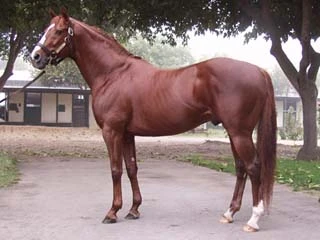
Dai Yusaku
1991 Arima Kinen winner at 137.9-1 odds.
Last updated

via Wikipedia: Dai Yusaku · see source
Dai Yusaku was a Japanese Thoroughbred who raced from 1988 through 1992, winning eleven times in thirty-eight starts. His career is defined by a single, staggering upset: the 1991 Arima Kinen, where he went off at 137.9-1 odds and defeated the overwhelming favorite Mejiro McQueen, stopping the clock in a Japanese record 2:30.6 for 2500 meters on turf.
Background
Dai Yusaku, a bay horse, was foaled in Hokkaido at Yushun Bokujo. His sire was the French stallion Nonoalco, and his dam, Kuninokiyoko, was sired by Daitakahata. The colt trained under Shigeharu Naito at the JRA's Ritto Training Center.
Racing career
Dai Yusaku first raced on October 30, 1988, at Kyoto Racecourse, where he placed eleventh in a dirt allowance race. His next outing at Fukushima Racecourse was even worse, finishing fourteenth and more than seven seconds behind the winner. Early on, he was plagued by chronic shin splints and a weak back, which made his performances so poor that retirement was discussed, along with a possible switch to jumping racing—a plan dropped over safety worries.
He finally broke through on April 16, 1989, winning a dirt allowance at Niigata Racecourse. A turf victory at Kyoto in May followed, and he then became the regular partner of jockey Shigefumi Kumazawa. That September, he set a track record of 1:08.9 for 1200 meters on firm ground while winning an allowance race at Hanshin Racecourse. After a layoff, he returned in June 1990 with a fourth-place finish in the CBC Sho (GII).
1991: Six-year-old season
Later that year, he took the Moonlight Handicap at Chukyo, the Topaz Stakes at Kyoto, and the Asuka Stakes, also at Kyoto. Kicking off 1991, he won the Kyōto Kimpai (GIII) on January 5. A second-place effort in the Sankei Osaka Hai (GII) in March was followed by a six-month break caused by a quarter crack. Back in the autumn, he ran unplaced in both the Kyoto Daishoten (GII) and the Swan Stakes (GII), then finished fifth in the Mile Championship (GI).
On December 7, he won the Hanshin Racecourse Renovation Memorial (Open). Just over two weeks later, on December 22, he entered the Arima Kinen (GI) at Nakayama. Despite that recent open-class win, bettors largely dismissed him, making him the 14th favorite at 137.9-1 odds. Mejiro McQueen, the heavy favorite at 1.7-1, seemed unbeatable.
1992: Seven-year-old season
But Kumazawa kept Dai Yusaku close to the pace, then drove him through an inside rail gap in the stretch to overtake Mejiro McQueen and win by 0.2 seconds. The time of 2:30.6 set a Japanese record for 2500 meters on turf, and the win ticket paid ¥13,790 in a stunning upset. He stayed in training through 1992 but never won again in six starts, with his best result a sixth in the Sankei Ōsaka Hai (GII). He also placed ninth in the Tennō Shō (Spring, GI), eighth in both the Yasuda Kinen and Takarazuka Kinen (both GI), and fifteenth in the Swan Stakes (GII) on October 31, after which he was retired.
Did You Know?
- Dai Yusaku's name was the result of a handwriting error: the katakana character for 'ko' was written to look like 'yu' on registration forms.
- His win ticket in the Arima Kinen paid ¥13,790, reflecting his 137.9-1 odds.
- He sired only 17 registered foals, with his best offspring being Grand Oracion, winner of the Grand Mix in the NAR circuit.
- Dai Yusaku died of old age on December 8, 2013, exactly 22 years after his Arima Kinen victory.
More in Thoroughbred Racehorses
Sources
Compiled from Wikipedia and the sources listed below. Text from Wikipedia is available under CC BY-SA 4.0; this entry is adapted from it.
- Wikipedia: Dai Yusaku (CC BY-SA 4.0).
- Currency conversion: European Central Bank euro reference rates, rates of 2 November 2026.
Spotted an error? Know more?
Reader corrections go straight into our review queue. Suggest an edit · How this site is sourced