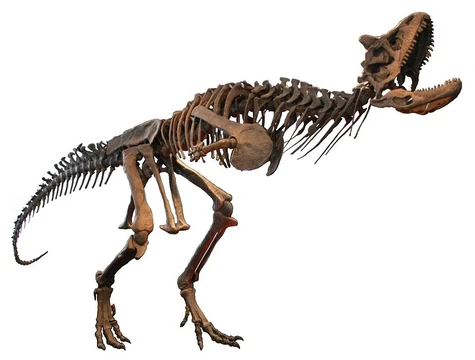
Zupaysaurus
A Late Triassic theropod from Argentina with disputed cranial crests.
Zupaysaurus is an extinct genus of early theropod dinosaur from the Late Triassic of Argentina. It was a bipedal predator reaching up to 4 meters in length, and its skull may have borne low ridges rather than the crests originally described.
Quick Facts
- Type species
- Zupaysaurus rougieri
- Holotype
- PULR-076
- Length
- approximately 4 m (adult)
- Skull length
- approximately 450 mm / 1 ft 6 in
- Geological age
- Norian stage, Late Triassic (at least 213 million years old)
- Formation
- Los Colorados Formation, Argentina
Facts from the source article.
Discovery
The holotype of Zupaysaurus was discovered in May 1997 by Santiago Reuil, a member of Guillermo Rougier's crew. Argentine paleontologists Andrea Arcucci and Rodolfo Coria described and named the genus in 2003 in the journal Ameghiniana. The name combines the Quechua word supay, referring to the Incan god of death and ruler of the underworld, with the Greek sauros for lizard. The type species Z. rougieri honors Guillermo Rougier, who led the expedition that collected the specimen. The holotype, PULR-076, comes from the upper part of the Los Colorados Formation and includes a nearly complete skull, right shoulder girdle, lower right leg and ankle, and twelve vertebrae. A smaller individual found at the same site may or may not belong to this genus.
Description
Zupaysaurus was a medium-sized theropod that walked on its hind legs. The adult skull measured about 450 mm in length, indicating a body length of roughly 4 m. Estimates of its size vary: Gregory S. Paul in 2010 suggested 6 m and 250 kg, while a 2016 estimate gave 4.2 m and 70 kg. The preserved neck bones indicate a rather long neck. Like coelophysoids, it had a kink in the snout between the premaxillary and maxillary bones. It is estimated to have had 24 teeth and an intermandibular hinge in the lower jaw. Originally, Arcucci and Coria (2003) described two thin parallel crests on top of the skull formed by the nasal bones, similar to those of Dilophosaurus and Coelophysis kayentakatae. However, a later redescription by Ezcurra (2007) reinterpreted these supposed crests as a displaced right nasal bone, with the nasal bones actually forming a flat upper edge of the snout with rough lateral ridges continuous with the lacrimal ridges. Distinctive features include a maxillary fenestra within the antorbital fossa, a ventrally bowed rostral process of the lacrimal, and a kinked ventral process of the squamosal.
Classification
Zupaysaurus was originally classified as the earliest known tetanuran theropod, but later analyses have placed it differently. Studies by Carano (2005), Tykoski (2005), and Ezcurra and Novas (2005) classified it as a coelophysoid related to Segisaurus and possibly Liliensternus. Yates (2006) placed it in a monophyletic Dilophosauridae with Dilophosaurus and Dracovenator. Later studies found Zupaysaurus to be a sister taxon to a clade containing dilophosaurids, ceratosaurs, and tetanurans.
Paleoecology
Zupaysaurus was discovered in red siliciclastic sediments at the Quebrada de los Jachaleros locality within the Los Colorados Formation in La Rioja province, Argentina. This formation dates to the Norian stage of the Late Triassic, approximately 228 to 208 million years ago, with more precise estimates constraining it between 227 and 213 million years ago. The environment was an ancient floodplain that hosted several early sauropodomorph dinosaurs, including Riojasaurus, Coloradisaurus, and Lessemsaurus. Non-dinosaurian contemporaries included pseudosuchians, therapsids like Cynodontia, other early reptiles, and possible archosaurs. The two specimens assigned to Zupaysaurus are housed at the National University of La Rioja.
More in Theropoda
Spotted an error? Know more?
Reader corrections go straight into our review queue. Suggest an edit · How this site is sourced