Three-Body Chaos
Three suns, no repeats, and a civilization that has died so many times it stopped counting.
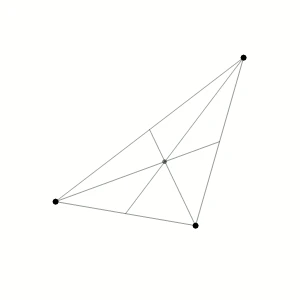
Three-Body Chaos is the gravitational nightmare at the heart of Liu Cixin's universe: the Trisolaran homeworld orbits three suns whose mutual gravitational tugs render their paths fundamentally unpredictable. Unlike a two-body orbit, which repeats in elegant ellipses, a three-body system is a perpetual act of celestial improvisation—stars loiter, slingshot, collide in near-misses, and then settle into temporary patterns that last only a few thousand years before dissolving into anarchy. Because their world cannot be predicted, the Trisolaran civilization has been repeatedly annihilated and reborn across geological time, and their desperate, centuries-long gamble to reach a stable four-sun system (the Solar System) is what brings the alien fleet toward Earth and sets the Dark Forest of the cosmos in motion.
Quick Facts
- System type
- Three-sun (Trisolaran) star system
- Core phenomenon
- Chaotic, non-repeating orbital dynamics (the three-body problem)
- Civilizational effect
- Alternating Stable Eras and Chaotic Eras; repeated extinction and revival
- Key consequence
- Trisolaran civilization's decision to migrate to a stable four-sun system (Earth's Solar System)
- First appears
- The Three-Body Problem (novel, 2008)
- Affiliation
- Trisolaran civilization
Lore & Background
In classical mechanics, two bodies in mutual gravity trace predictable, repeating orbits. Add a third, and the system becomes analytically unsolvable: tiny perturbations compound, and the long-term future of the configuration is, in principle, unknowable. The Trisolaran system is a living illustration of this principle on a civilizational scale. Their world experiences 'Stable Eras'—spans of a few thousand years during which the three stars settle into a quasi-periodic dance and the planet's climate permits agriculture, industry, and culture. Then the geometry shifts, a star drifts too close, and the 'Chaotic Era' begins: oceans boil, the atmosphere ignites, or the world is plunged into a multi-century freeze. The civilization is wiped out. Survivors huddle in subsurface shelters, preserving fragments of knowledge, waiting for the next stable window to rebuild from almost nothing.
This cycle of annihilation and resurrection has repeated so many times that the Trisolarans' collective memory is a palimpsest of lost epochs. Their science, art, and even their language carry the scar of impermanence. The 'Three-Body' virtual-reality game that a human player encounters in the novel is, in essence, a Trisolaran cultural artifact: a simulation of their ancestral suffering, designed to make an outsider feel the chaos rather than merely calculate it. The game's rules—sudden solar flares, unpredictable star approaches, the fragile hope of a stable window—mirror the real system's behavior.
The chaos also forges the Trisolaran strategic mindset. A species that cannot trust its own sky to remain benign for more than a few millennia will not trust the long-term stability of any other system unless it is geometrically guaranteed. Earth's Solar System, with its four stars (the Sun plus three dimmer companions in the Trisolaran model), is the first configuration they can project forward with confidence. That single insight—'a four-sun system is stable'—converts existential terror into a fleet, a message, and a 400-year transit that will reshape human history.
Reader's Guide
In the deep past, three protostars condensed from the same collapsing cloud and locked into a gravitational tango with no repeating measure. The first Trisolaran organisms evolved in a narrow window of that tango's rare gentleness. Civilizations rose, flourished, and were erased by a star that drifted too close. They rose again. And again. Thousands of cycles compressed into a single geological blink.
Each death stripped the culture thinner; each revival rebuilt it from a handful of survivors in a cave. The Trisolarans learned to encode everything—math, poetry, the memory of a blue sky—into the most durable substrate they could make. The Three-Body game is one such encoding: a playable grief, a simulation of the chaos so that a stranger might understand why a species would stake its entire future on a star system it has never seen.
When a Trisolaran astronomer finally projected the Solar System's four-star geometry forward and found it stable, the decision was not debated. It was a relief. A species that has watched its suns betray it ten thousand times does not argue with the one configuration that keeps its promises. The fleet was built. The message was sent. And on a quiet night, a human named Ye Wenjie, standing in a radio-dish facility in the Chinese interior, pressed the transmit key and answered a question she was never meant to hear. The chaos of three suns became, for the first time in Trisolaran memory, a problem with a destination.
Did You Know?
- The three-body problem in classical physics has no general closed-form solution; the Trisolaran system is a literal, civilizational-scale dramatization of that mathematical fact.
- The novel's title is a deliberate double meaning: it refers simultaneously to the physical three-body problem and to the three intertwined 'bodies' of the story—humanity, the Trisolarans, and the cosmic Dark Forest.
More in Lore & Cosmological History
Elsewhere in The Three-Body Problem
Spotted an error? Know more?
Reader corrections go straight into our review queue. Suggest an edit · How this site is sourced