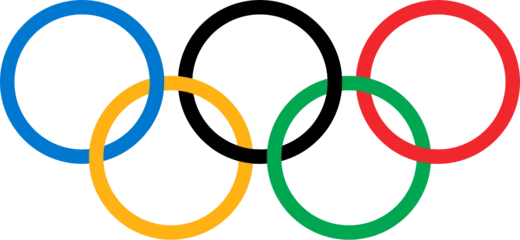
Olympic Flag
Five rings, one white field, the whole world held in a single banner.
The Olympic Flag is the single most recognizable symbol of the Olympic Games: a white field bearing five interlocking rings in blue, yellow, black, green, and red. Designed by Pierre de Coubertin in 1913, the flag was conceived as a universal emblem that could represent every nation and every inhabited continent simultaneously, transcending any single country's colors or heraldry. It is not a national flag but a flag of the movement itself, raised and lowered at every Summer and Winter Games as a mark of the Games' opening and closing.
Throughout the ceremony, the flag serves as the visual anchor of Olympic identity. It is carried into the stadium ahead of the athletes, hoisted on the central flagpole during the opening ceremony, and ceremonially handed from the departing host city to the incoming one at the closing ceremony. In that handover, the flag becomes a living relay baton of trust, continuity, and shared purpose across generations of host cities.
Quick Facts
- Designer
- Pierre de Coubertin
- Year designed
- 1913
- Ring colors
- Blue
- Yellow
- Black
- Green
- Red
- Field color
- White
- Symbolic meaning
- Unity of the five inhabited continents; the colors appear in every national flag
Lore & Background
When Pierre de Coubertin sketched the five interlocking rings in 1913, he was searching for a symbol that belonged to no single nation. He chose the six colors—five in the rings plus the white ground—because, he noted, every national flag in the world contained at least one of them. The rings themselves, overlapping in a chain, were meant to express the coming together of the continents in sport. The flag was not yet in use: the 1914 Games in Brussels had been cancelled by war, and the design waited in a drawer for six years.
At Antwerp in 1920, the flag was raised for the first time over a stadium, and from that moment it became inseparable from the spectacle. Over the decades it has been carried by runners, draped over podiums, and unfurled against night skies in cities from Los Angeles to Tokyo to Paris. Each host city receives the flag at the closing ceremony and returns it at the next opening, a quiet ritual of stewardship that has continued uninterrupted across a century of Games.
The flag also carries the Olympic motto, 'Citius, Altius, Fortius'—Faster, Higher, Stronger—inscribed beneath the rings on the official banner. In 2021 the IOC added the word 'Communiter' (Together), broadening the creed to emphasize collective effort alongside individual excellence. The flag thus speaks not only of competition but of a shared human project, renewed every four years.
Reader's Guide
The Olympic Flag is the ceremonial heart of both the opening and closing ceremonies. At the opening, it is carried into the stadium by a designated bearer—often a young athlete or a member of the host nation's youth—then hoisted on the central flagpole while the Olympic anthem plays. The flag remains raised for the duration of the Games, a constant visual presence above the track, the pool, the arena.
At the closing ceremony, the ritual reverses. The flag is lowered, folded with care, and presented by the outgoing host city's mayor to the President of the International Olympic Committee. The IOC President then hands it to the mayor of the next host city. This handover is the Games' most solemn transfer of responsibility: one city's stewardship ends, another's begins.
Notable variations across host cities include the choice of bearer (a single child in some Games, a pair of young athletes in others), the height and design of the flagpole, and whether the flag is unfurled by wind or by a mechanical rig. In Tokyo 2021, the flag was carried by a runner in a traditional Japanese kimono; in Paris 2024, the presentation incorporated elements of French civic ceremony. Yet the core meaning remains unchanged: the flag is not owned by any city. It is borrowed, honored, and passed on—a banner of the world's athletes, belonging to the future as much as the past.
Did You Know?
- The Olympic Flag was designed in 1913 but was not first flown at the Games until 1920 in Antwerp, because the 1916 Berlin Games were cancelled by World War I.
- The flag is physically handed from one host city to the next at every closing ceremony, a tradition that has continued from Antwerp 1920 through every subsequent Games.
- The five interlocking rings are not arranged in a fixed topological order; their overlapping pattern is the same regardless of which ring is considered 'first,' symbolizing that no continent or nation takes precedence.
More in Ceremonies & Traditions
Elsewhere in The Olympics
Spotted an error? Know more?
Reader corrections go straight into our review queue. Suggest an edit · How this site is sourced