Destruction and Rebirth
Every ending in this universe is just the universe taking a breath before it begins again.
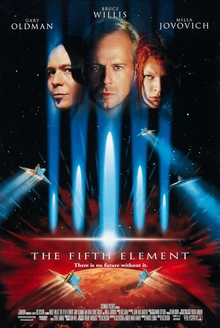
Destruction and Rebirth is the philosophical spine of Luc Besson's 1997 sci-fi spectacle The Fifth Element. The film's entire narrative is engineered around a cyclical principle: a cosmic force of annihilation returns on a fixed schedule, and only the convergence of four elemental forces into a singular 'Perfect Being' can restore balance. What begins as a quip about a new car in a New York bar becomes, by the final frame, a meditation on how endings are merely the soil from which new life erupts.
The theme is not merely decorative; it dictates the plot's circular architecture, the visual language of the score, and the emotional arc of every major character. Destruction is never presented as a final state in this world—it is always a threshold, a necessary clearing before the next act of creation begins.
Quick Facts
- Theme role
- Central structural and philosophical pillar of the film
- First expressed
- Opening narration explaining the cyclical return of the black comet
- Antithetical force
- The Ankhra-Poor (the black comet)
- Embodied by
- Leeloo, the Fifth Element; Perfect Being
- Narrative structure
- Circular — the film's final scene mirrors its opening
- Director
- Luc Besson
- Release year
- 1997
Lore & Background
In the cosmology Besson constructs, the universe operates on a vast clock. Every five thousand years, a black comet—called the Ankhra-Poor—sweeps through the galaxy, erasing all life in its path. The only countermeasure is the 'Perfect Being,' a living synthesis of the four elemental forces (fire, water, earth, and air) that can project a beam of pure light to scatter the comet. This is not a one-time event; the narration makes clear it has happened before and will happen again. Destruction is not an anomaly. It is the rhythm.
Leeloo embodies this rhythm in her very body. She is the living proof that the four elements can be unified, and her existence is both a miracle and a weapon. When she is shot and her body dissolves into a cascade of luminous particles, the audience expects an ending. Instead, those particles reassemble. She breathes again. The film refuses to let death be a period; it insists on the comma. Rebirth is not a reward for surviving destruction—it is the mechanism by which destruction is rendered meaningless.
This cycle also governs the human characters. Korben Dallas is killed, resurrected, and sent back to the very bar where the story began. The city is shattered and rebuilt. The 'Perfect Being' is created, spent, and reformed. Besson treats the universe less like a linear story and more like a heartbeat: systole, diastole, systole, diastole. Each beat of destruction makes the next beat of life more urgent, more vivid, more necessary.
Reader's Guide
The theme is announced in the first minute. The opening narration, delivered over a sweeping shot of the cosmos, lays out the five-thousand-year cycle of the black comet and the necessity of the Perfect Being. Besson is telling the audience before a single character speaks: this story will end the way it began, and that is the point.
The destructive half of the cycle is personified by the Ankhra-Poor and its minions. The comet's arrival shatters the city's skyline; the 'Minions' of the comet reduce entire districts to rubble. Visually, destruction is rendered in cold blues, blacks, and the hard geometry of the comet's shadow. It is impersonal, mechanical, and total.
Rebirth is rendered in warm golds, the iridescent skin of Leeloo, and the soft focus of her reformation scene. When she is shot and her body breaks apart into a shower of light, the camera lingers on the particles drifting upward. Then they spiral, slow, and reassemble. Besson holds the shot just long enough for the audience to grieve before the healing completes. The message is explicit: the universe does not move forward in a line. It moves in a spiral, and each loop is slightly higher.
The circular structure reinforces this. The film's final image—Dallas back in the bar, the same line about the weather, the same glass of whiskey—mirrors the opening. The plot has completed one full rotation of the cycle. The next rotation is already implied. Besson is saying that meaning in this universe is not found in a destination but in the turning itself.
Did You Know?
- The film's circular structure means the final scene is a deliberate echo of the opening bar scene, reinforcing that the story has completed one full cycle of destruction and renewal.
- Leeloo's disintegration-and-reformation sequence near the film's climax is one of the few moments where the 'Perfect Being' concept is shown as a living, physical process rather than an abstract idea.
- The Ankhra-Poor's five-thousand-year return interval is stated in the opening narration, framing the entire plot as one small rotation in an almost incomprehensibly long cosmic clock.
More in Themes & Symbolism
Elsewhere in The Fifth Element
Spotted an error? Know more?
Reader corrections go straight into our review queue. Suggest an edit · How this site is sourced