Cid's Shadow Arts
The darkness does not hide him—it obeys him.
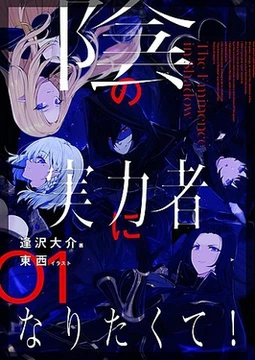
Cid's Shadow Arts is the signature magical discipline of Cid Kagetsuboshi, the self-styled 'Eminence in Shadow' and absolute leader of the clandestine organization known as the Shadow Garden. Rooted in the manipulation of shadow itself—its shape, density, and autonomy—this power set allows Cid to conjure weapons, spawn doppelgänger clones, phase through darkness, and channel a semi-sentient shadow entity that fights alongside him as a second body. It is the single most important combat tool in the series and the foundation upon which Cid's entire identity as a 'master of the shadows' is built.
In narrative terms, the Shadow Arts serve as both a literal weapon and a metaphor: they externalize Cid's desire to be the invisible hand behind every crisis, the unseen force that tips the balance before anyone even knows a fight has begun. Every major set-piece in the story is anchored by Cid deploying some facet of this power, making it the visual and thematic signature of the protagonist.
Quick Facts
- User
- Cid Kagetsuboshi (leader of the Shadow Garden)
- Type
- Shadow-based magical discipline
- Affiliation
- Shadow Garden (sole leader)
- First appears
- Volume 1, Chapter 1
- Status
- Active and continuously developed
- Core functions
- Shadow construct creation
- doppelgänger cloning
- shadow-phase movement
- semi-autonomous shadow entity
Lore & Background
Cid's Shadow Arts are not a school of magic he studied in an academy or inherited from a lineage; they are an innate, almost parasitic bond between his will and the shadow that clings to his body. From the earliest moments of the story, his shadow behaves as though it has a pulse of its own—stretching, curling, and detaching at his command. This is not a spell he casts in the conventional sense; it is a reflex, as natural to him as breathing. The shadow responds to intention before intention fully forms, which is why his opponents so often find themselves struck before they register an attack.
The most distinctive aspect of the discipline is the 'Shadow' itself: a dark, humanoid silhouette that Cid can project, extend, and command as a separate combatant. It can swing blades, grapple enemies, and reposition independently while Cid's physical body is elsewhere. To onlookers this reads as a single, terrifying entity with two bodies. In Cid's own mind, the Shadow is his loyal instrument, his 'right hand in darkness,' and he narrates its actions as if conducting an orchestra of shadow. In practice, the Shadow is more reactive and less refined than his self-image suggests—it lags a beat, occasionally overextends, and must be recalled before it can be re-deployed.
Over the course of the series the Shadow Arts grow in scope. Early on they are limited to a single shadow blade and a brief phase-step. By later arcs Cid can field multiple shadow clones simultaneously, weave shadow into the environment to create traps and barriers, and sustain the Shadow entity for extended engagements. The power never becomes 'omnipotent,' but its ceiling keeps rising in step with the threats Cid faces, ensuring it remains the narrative's central axis of force without ever feeling unbounded.
Reader's Guide
Cid's Shadow Arts operate on a simple internal logic: his will shapes shadow, and shadow obeys. There is no incantation, no gesture, no mana-cost meter. He thinks the shape, and the darkness around him answers. In combat this means he can produce a blade, a chain, a cage, or a full humanoid clone in the span of a heartbeat, and he can dissolve any of them just as quickly. His shadow-phase movement lets him step into a patch of shade and re-emerge three meters away, effectively granting him short-range teleportation with no cooldown visible to the reader.
The Shadow entity is the most advanced application. Cid projects a dark, roughly humanoid silhouette that fights with its own momentum. It can grapple, slash, and reposition while Cid's body is elsewhere, creating a two-front assault. The limitation is sustainability: the longer the Shadow is deployed, the more Cid's own composure frays, and he must recall it before it can be struck and dispersed.
What Cid believes versus what actually happens is a running joke of the series. In his head, he is conducting an elaborate symphony of shadow, each clone a carefully placed note, each blade a stroke of a master's brush. In reality, the Shadow is a blunt instrument that responds to his intent with a slight lag, and his 'elaborate choreography' is often just him being fast, reading the opponent, and swinging a shadow-sword at the right moment. The gap between his self-narrative and the mechanical truth is where much of the series' humor lives.
Narratively, the Shadow Arts are the visual shorthand for Cid's agency. Every time the story needs the protagonist to tip a battle, the answer is the same: the shadows move. It is never flashy enough to feel like a cheat, but always decisive enough to keep him at the top of the power hierarchy without requiring a new ability every arc.
Did You Know?
- Cid's shadow can act semi-independently, meaning he can be in one location while his shadow entity is grappling an opponent in another, creating a genuine two-body combat style.
- The Shadow Arts require no verbal incantation or hand-seal; they respond to Cid's intent almost reflexively, which is why his attacks are so difficult for opponents to predict or counter.
- The Shadow entity has a sustainability limit: prolonged deployment strains Cid's composure, and he must recall it before it can be struck and dispersed, which creates a natural tactical ceiling in extended fights.
More in Powers & Artifacts
Elsewhere in The Eminence in Shadow
Spotted an error? Know more?
Reader corrections go straight into our review queue. Suggest an edit · How this site is sourced