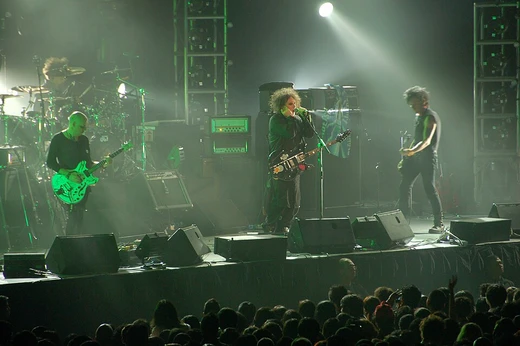
Steven Severin
The dry-voiced poet who anchored The Cure's sound for over four decades.

Andwhatsnext at English Wikipedia · via Wikipedia: Steven Severin · CC BY-SA 3.0
Steven Severin is the bassist of The Cure, the band's longest-tenured member after frontman Robert Smith. He joined the group in 1982, stepping into a role that Smith had been filling himself during the band's earliest years, and has remained a constant presence in the lineup ever since. Beyond his work behind the amp, Severin is a published poet, a visual artist, and a figure known across the music world for his razor-sharp, deadpan wit.
His arrival marked a turning point in The Cure's sound: where the early albums leaned on Smith's layered guitar and jangly textures, Severin brought a grounded, melodic bass voice that gave the music a new low-end architecture. From the gothic darkness of Pornography through the synth-driven peaks of Disintegration and onward to the present day, his playing has been the quiet scaffolding beneath the band's most recognizable songs.
Quick Facts
- Birth name
- Steven John Bailey
- Born
- 25 September 1955
- Birthplace
- Highgate, London, England
- Instrument
- Bass guitar, keyboards
- Genre
- Post-punk
- gothic rock
- alternative rock
- new wave
- Occupation
- Musician
- songwriter
- producer
- Years active
- 1976–present
- Label
- Polydor
- Geffen
- RE:
- Subconscious Music
Facts from the source article.
Lore & Background
When Robert Smith formed The Cure in the mid-1970s, he handled bass duties himself, and the early recordings carried that DIY, guitar-drenched quality. By 1982, the band was preparing for a far darker and more ambitious record, and they brought Severin in to handle the low end. His first contribution, the bass work on Pornography, helped give those songs a heavier, more deliberate pulse beneath the brooding guitar and the new drumming of Lol Tolhurst. From that point forward, Severin's role was not merely to keep time but to write counter-melodies that wove through Smith's guitar lines, creating the interlocking harmonic texture that defines The Cure's sound.
Severin's personality has always been a counterweight to the band's theatrical, gothic public image. Where Smith is the storm, Severin is the flat, amused observer. His dry one-liners in interviews, his wry stage banter, and his published poetry collections have made him a beloved figure among fans who appreciate the band's humor as much as its melancholy. He has also exhibited visual art, adding another layer to his creative output beyond music.
His continuity within the band is remarkable. Through lineup changes in the drum chair, through the synth-heavy mid-80s, through the 90s and 2000s, through the pandemic-era hiatus and the 2022 reunion, Severin has been the one constant thread. His bass lines on songs spanning four decades form a through-line that fans can trace from the first note of Pornography to the latest live set, a quiet but indispensable signature.
Reader's Guide
Steven Severin's role in The Cure is that of bassist, a position he has held without interruption since joining the band in 1982. His first studio appearance is on Pornography, and he has contributed bass to every subsequent Cure album, including Disintegration, Wish, Headlines Here, Galore, Bloodflowers, 4:13 Dream, and the later releases through the 2010s and 2020s.
His musical contribution is best understood as melodic counterpoint. Rather than simply tracking the root notes of the chord progression, Severin's lines often move independently, weaving arpeggiated patterns or sustained drones that interact with Robert Smith's guitar work. On the synth-heavy records of the mid-1980s, his bass provided the organic, human low end that kept the arrangements from feeling purely electronic. On the more guitar-driven material of the 1990s and beyond, his playing carves out space and rhythm that lets the other instruments breathe.
His arrival shifted the band's sound by giving it a dedicated low-end voice for the first time. Before Severin, the bass part was an afterthought layered under Smith's guitar. After him, the bass became a lead instrument in its own right, and the band's arrangements grew more layered and dynamic. His departure has, to date, never occurred — his continuous presence makes him the structural backbone of the group's identity.
More in Band Members & Collaborators
Elsewhere in The Cure
Spotted an error? Know more?
Reader corrections go straight into our review queue. Suggest an edit · How this site is sourced