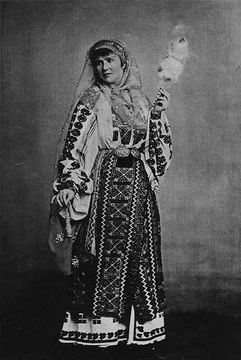
The Six Swans
A silent sister sews star-flower shirts to free her swan brothers.
"The Six Swans" is a German fairy tale collected by the Brothers Grimm in 1812, classified as Aarne–Thompson type 451. It belongs to a widespread European tale type in which a sister must remain silent while sewing shirts to break a spell that has transformed her brothers into birds. The story has been retold in numerous variants across Europe, the Middle East, India, and Japan.
Quick Facts
- Aarne-thompson grouping
- ATU 451
- Country
- Germany
- Published in
- Grimms' Fairy Tales
Facts from the source article.
Did You Know?
- The Brothers Grimm's source was Wilhelm Grimm's friend and later wife Henriette Dorothea (Dortchen) Wild.
- The tale was substantially rewritten for the second edition in 1819.
Synopsis
A king lost in a forest agrees to marry a witch's daughter to find his way home. Fearing for his six sons and one daughter from his first marriage, he hides them in a forest castle, visiting them with a magical reel of thread. The new queen, also a witch, bribes servants, learns the secret, and sews seven white shirts. When the king is away, she follows the reel to the castle; the princes mistake her for their father and rush out, and she throws the shirts over them, turning them into swans. The sister, who remains human, tells her father what happened and then runs away, finding her brothers in a robbers' hut. Each evening they regain human form for fifteen minutes and reveal the only cure: for six years she must not speak while sewing six shirts from star-flowers. She agrees and lives in a tree, gathering flowers and sewing in silence. In the fourth year, a young king finds her, marries her, and takes her to his kingdom. His wicked mother, disapproving, kidnaps the queen's first child and accuses her of eating the baby, but the king refuses to believe it.
Analysis
Folklorist Stith Thompson traced the tale type's literary history back to the 12th-century Dolopathos, which later fed into the Knight of the Swan legend. Jack Zipes noted that the Brothers Grimm suspected a Greco-Roman origin, with parallels in French and Nordic oral traditions. Joseph Jacobs observed that the Continental tale of seven swans or ravens became connected to the medieval Knight of the Swan cycle.
Variants
The tale type is widely recorded across Europe, the Middle East, India, and the Americas, with over two hundred European versions alone. French scholar Nicole Belmont distinguished a Germanic-Scandinavian form and a western version in which a tree sprouts fruit that causes transformation. Japanese variants, called Nanaha no hakuchō, are found only on Kikaijima and Okinoerabujima, with additional variants noted in Kagoshima. A literary predecessor is Giambattista Basile's The Seven Doves, where brothers become doves. In other European variants the number of brothers ranges from three to twelve; Danish collector Mathias Winther published De elleve Svaner in 1823, and a Ligurian tale is titled Les onze cygnes. Hungarian collector Elisabeth Sklarek compiled Die sieben Wildgänse and Die zehn Geschwister, and a third Hungarian variant is A tizenkét fekete várju. Ludwig Bechstein collected The Seven Crows and The Seven Swans. An Irish variant was noted by Patrick Kennedy, and Louis Brueyre linked it to the Indian tale Truth's Triumph, in which a girl's one hundred brothers become crows. In a Lithuanian variant, the stepmother demands the king kill his sons and bring her their ashes.
Cultural legacy
Juliet Marillier's Daughter of the Forest, the first book of the Sevenwaters trilogy, retells the story in a medieval Celtic setting: Sorcha must sew six shirts from nettles while mute to save her six brothers from a witch's enchantment, and her task is complicated by love for a British lord. The 1977 anime film The Wild Swans by Toei Animation combines elements of this tale and Hans Christian Andersen's version, with Eiko Masuyama voicing Princess Eliza. The queen finishes the shirts in time, so no brother retains a swan wing, and the stepmother accidentally catches fire from the execution pyre and burns to death.
More in Textiles in Folklore
Spotted an error? Know more?
Reader corrections go straight into our review queue. Suggest an edit · How this site is sourced