Frequently Asked Questions
The most-asked questions about tetrarchy.
What is the Tetrarchy?
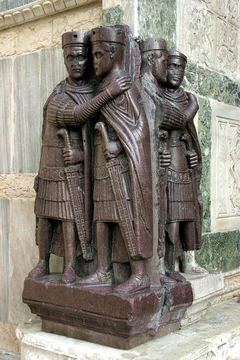
The Tetrarchy was a late-Roman system of government, established around 293 AD, that divided imperial authority among four co-rulers to make the vast territory more governable. It split the empire into eastern and western halves, each headed by a senior emperor (Augustus) and a junior emperor (Caesar) who would succeed him.
Who created the Tetrarchy and why?
Emperor Diocletian instituted the system in the late third century to address the chronic instability, border threats, and administrative overload that had plagued the empire since the Crisis of the Third Century. By sharing power with trusted colleagues rather than relying on a single heir, he hoped to prevent the succession crises that had devastated the preceding decades.
Who were the original four rulers?
The first tetrarchic college consisted of Diocletian (Augustus of the East) and Maximian (Augustus of the West), with their Caesars being Galerius in the East and Constantius Chlorus in the West. This initial quartet governed from roughly 293 until Diocletian's retirement in 305.
How did succession work under the Tetrarchy?
Each Augustus was paired with a Caesar who served as his designated successor, so that upon an Augustus's retirement or death, his Caesar would be elevated and a new Caesar appointed to fill the vacancy. In practice the scheme broke down almost immediately, because emperors favored their own relatives or allies over their designated Caesars.
When and why did the Tetrarchy collapse?
The system effectively disintegrated after Diocletian's abdication in 305, as rival claimants—including Constantine, son of Constantius—seized power and refused to recognize the seniority rules. A series of civil wars from 306 to 312 ended the four-man arrangement, culminating in Constantine's victory at the Milvian Bridge.
What was the Diocletianic Persecution?
It was a series of empire-wide edicts issued between 303 and 311 that targeted Christians, ordering the destruction of churches, confiscation of scriptures, and imprisonment or execution of clergy. It stands as the last systematic state-sponsored persecution of Christians before Constantine's Edict of Milan in 313 brought legal tolerance.
Where were the tetrarchic capitals?
Diocletian and his colleagues established four major administrative centers: Trier in the west for Constantius, Sirmium (in modern Serbia) for Galerius, Nicomedia (in modern Turkey) for Diocletian, and later Mediolanum (Milan) as a western seat. These cities served as the operational bases from which each tetrarch governed his quarter.
Who was Constantine the Great in relation to the Tetrarchy?
Constantine, son of Constantius Chlorus, was never formally appointed Caesar under the tetrarchic rules but was proclaimed emperor by his troops in York in 306. His rise shattered the system's succession logic, and his eventual military dominance by 312 made him sole emperor, ending the Tetrarchy for good.
What should a newcomer read first to understand the Tetrarchy?
A solid starting point is a general late-Roman history such as Edward Gibbon's The History of the Decline and Fall of the Roman Empire, particularly the chapters covering 284–324. For a more focused narrative, David Potter's The Roman Empire at Bay contextualizes the military pressures that made the Tetrarchy seem necessary.
What is the Arch of Galerius and why does it matter?
It is a triumphal arch in Thessaloniki, built around 300 AD by Galerius to celebrate his military victories and his role within the tetrarchic system. It is one of the best-preserved examples of late Roman monumental architecture and serves as a physical reminder of the Tetrarchy's brief but ambitious political experiment.