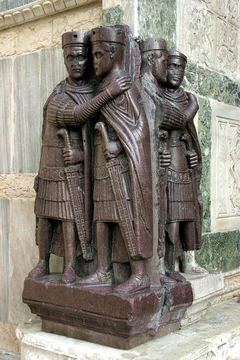
Candidianus (son of Galerius)
Son of Galerius, adopted by Galeria Valeria, executed by Licinius.
Last updated

如此甚好 · CC BY 4.0
Candidianus (c. 296–313) was the son of the Roman Emperor Galerius and adoptive son of Galeria Valeria, the wife of Galerius and daughter of Diocletian and Prisca.
Quick Facts
- Died
- 313
Facts from the source article.
Lore & Background
Candidianus was born around 296 to the Roman emperor Galerius and an unnamed mistress. He was later adopted by Galerius’s wife, Galeria Valeria, who had no children of her own. According to the writer Lactantius, Galerius planned to elevate Candidianus to the rank of Caesar, a junior emperor, at a celebration scheduled for 312.
But Galerius died in 311 while preparations were still going on, and power passed to Maximinus Daza and Licinius. Fearing what Licinius might do, Candidianus and Severianus, the son of the former emperor Severus II, fled to Daza’s court and stayed there until 313. Around this time, Candidianus was betrothed to Daza’s daughter, who was then seven years old.
After Licinius defeated and killed Daza in a civil war, Candidianus was captured in 313. Lactantius reports that Candidianus went to Licinius’s court and was treated with respect, but as soon as the young man felt secure, Licinius ordered his execution. The unnamed betrothed girl and her brother, Maximus, were also killed.
Birth and Position in the Imperial Household
Candidianus came into the world around 296 as the son of the Roman Emperor Galerius and a mistress whose name history has not preserved. His mother's anonymity left him in a precarious social position, outside the legitimate line of the imperial family. Galerius's lawful wife was Galeria Valeria, the daughter of Diocletian and Prisca, and she had no children of her own. That changed when Valeria formally adopted the boy, drawing him into the dynastic circle through a legal act of maternal claim.
The adoption was consequential: it tethered Candidianus to the broader imperial lineage that stretched back through Diocletian, the senior figure whose name anchored the entire arrangement. Galerius and Valeria's own marriage had been a political bond linking the imperial houses, and Candidianus, though born to a concubine, was elevated by that adoption into a position of dynastic significance. He carried the blood of one of Rome's most powerful rulers yet remained, in the eyes of strict succession, a step above common birth only because Valeria chose to make him her son.
The Vicennalia and a Succession That Never Came
The early Christian writer Lactantius records that Galerius had a concrete plan for his son's future. The emperor intended to elevate Candidianus to the rank of Caesar, the junior imperial title that would have set the young man on a path toward full sovereignty. The promotion was to be announced at the celebration of Galerius's vicennalia, the twentieth anniversary of his accession, which was slated for 312. The timing was deliberate, a father bestowing imperial dignity upon his son at the height of his own prestige.
Yet Galerius died in 311, while preparations for the ceremony were still in progress, and the entire scheme collapsed with him. His successors, Maximinus Daza and Licinius, inherited the throne but not the obligation to honor Galerius's wishes. The vicennalia never took place, the Caesar title vanished, and Candidianus was left a boy of roughly fifteen, stripped of the patronage he had been promised and suddenly exposed in a political landscape that had shifted without warning.
Flight to Daza's Court and a Child's Betrothal
With Galerius dead and Licinius consolidating power as a rival, Candidianus faced a very real threat to his life. He fled alongside Severianus, the son of the late emperor Severus II, and the two young men took refuge at the court of Maximinus Daza. Daza's household became Candidianus's home for the remainder of his short existence, a period extending until 313. During those years, a political marriage was arranged: Candidianus was betrothed to Daza's daughter, who was only seven years old at the time.
The union served a transparent dynastic purpose, stitching together the claims of two rival families and potentially forging a united front against Licinius. For Candidianus, the betrothal was simultaneously a mark of Daza's trust and a deeper entanglement in the civil war that was gathering. He was no longer simply the grieving son of a dead emperor; he had become a political asset, a prospective son-in-law of a living one, whose fate was now inextricably bound to the outcome of the struggle between Daza and Licinius.
Betrayal at Licinius's Court and the Final Annihilation
In 313 the balance of power tipped decisively when Licinius defeated and killed Maximinus Daza in civil war. With Daza's death, Candidianus lost his protector, and his position became untenable. Lactantius recounts that the young man then presented himself at the court of Licinius, where he was received with apparent honor and courtesy.
That reception, however, was a trap. Lactantius records that the moment Candidianus felt himself secure, trusting the outward show of respect and believing his life was safe, Licinius had him put to death. The killing did not stop with him.
His young betrothed, Daza's daughter, and her brother Maximus also lost their lives. The execution of a child bride and her brother alongside the young Candidianus suggests that Licinius sought to sever every thread of Daza's dynastic claim and every potential alliance that might challenge his authority. What had begun as a political betrothal to secure a future ended in the annihilation of an entire generation of would-be claimants.
Reader's Guide
The claim that he was captured in 313 after Maximinus Daza's death is directly stated in the source. The statement about Galerius intending to make him a Caesar upon his vicennalia in 312 is recorded by Lactantius in the source, though Galerius died in 311.
More in Tetrarchy
Sources
Compiled from Wikipedia and the sources listed below. Text from Wikipedia is available under CC BY-SA 4.0; this entry is adapted from it.
- Wikipedia: Candidianus (son of Galerius) (CC BY-SA 4.0).
Spotted an error? Know more?
Reader corrections go straight into our review queue. Suggest an edit · How this site is sourced