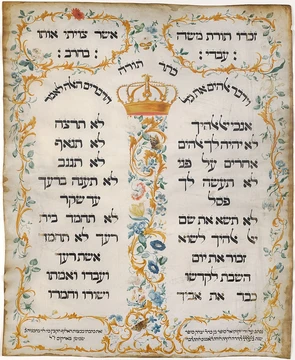
Tablets of Stone
Stone tablets inscribed with the Ten Commandments given to Moses.
Last updated
The Tablets of Stone, also known as the Tablets of the Law or Tablets of Testimony, are the two stone slabs that, according to the Hebrew Bible, were inscribed with the Ten Commandments. They were given to Moses on Mount Sinai and later placed in the Ark of the Covenant. The tablets are central to the biblical narrative of the covenant between God and Israel.
Quick Facts
- Material (rabbinic tradition)
- blue sapphire (or lapis lazuli)
- Shape (rabbinic tradition)
- square or rectangular with sharp corners
- Number of sets
- two
- Storage location
- Ark of the Covenant
Facts from the source article.
Covenantal interpretation in Jewish tradition
In rabbinic and medieval Jewish thought, the tablets are seen as covenantal documents formalizing the relationship between God and Israel. The Mekhilta of Rabbi Ishmael calls them testimony of the Sinai covenant, while the Sifre Deuteronomy emphasizes their role as a witness to mutual obligations. Nachmanides, commenting on Exodus 24:12, explains that the tablets contain the written terms of the brit (covenant), with the Ten Commandments as foundational stipulations akin to ancient Near Eastern suzerainty treaties. Placing the tablets in the Ark parallels the practice of depositing treaty documents in temples as sacred witnesses.
Breaking of the first tablets
Rabbinic interpretation portrays Moses' breaking of the first tablets not as uncontrolled anger but as a necessary, divinely sanctioned response to Israel's violation of the covenant through the golden calf. The Talmud (Shabbat 87a) records God affirming Moses' action with the words 'Well done for breaking them.' Rashi explains that Moses reasoned that if a single non-idolatrous Israelite could not eat the Passover offering, the entire nation should be denied the tablets after committing idolatry. Exodus Rabbah compares the breaking to annulling a marriage contract when one party violates its terms, reflecting the spiritual rupture that had already occurred.
Appearance of the tablets
Recent popular depictions often show the tablets as round-topped rectangles, but rabbinic tradition describes them as rectangles with sharp corners, as seen in 3rd-century paintings at the Dura-Europos Synagogue and in early Christian art. Round-topped depictions appeared in the Middle Ages, modeled on contemporary hinged writing-tablets with wax interiors.
Michelangelo and Andrea Mantegna still depicted sharp corners, while later artists like Rembrandt combined rounded shapes with larger sizes. According to the Talmud, each tablet was square, six tefachim (about 50 cm) wide and high, and three tefachim (about 25 cm) thick, though some sources say they were rectangular. The words were bored fully through the stone, not engraved on the surface.
In the Quran
The Quran states that tablets were given to Moses, without quoting their contents explicitly. It mentions that God wrote on them instruction and explanation for all things. Unlike the biblical account, these tablets are not broken; Moses threw them down in anger but later picked them up. After his anger subsided, Moses took up the tablets, and in their inscription was guidance and mercy for those who fear the Lord.
Did You Know?
- The first tablets were entirely divine in origin, while the second required Moses to hew the stone himself.
- The tablets are referred to as luhot ha-berit ('tablets of the covenant') and luhot ha-edut ('tablets of testimony').
More in Ten Commandments
Sources
Compiled from Wikipedia and the sources listed below. Text from Wikipedia is available under CC BY-SA 4.0; this entry is adapted from it.
- Wikipedia: Tablets of Stone (CC BY-SA 4.0).
Spotted an error? Know more?
Reader corrections go straight into our review queue. Suggest an edit · How this site is sourced