
Bio Booster Armor Guyver
A symbiotic armor merges with hosts to fight a global conspiracy.

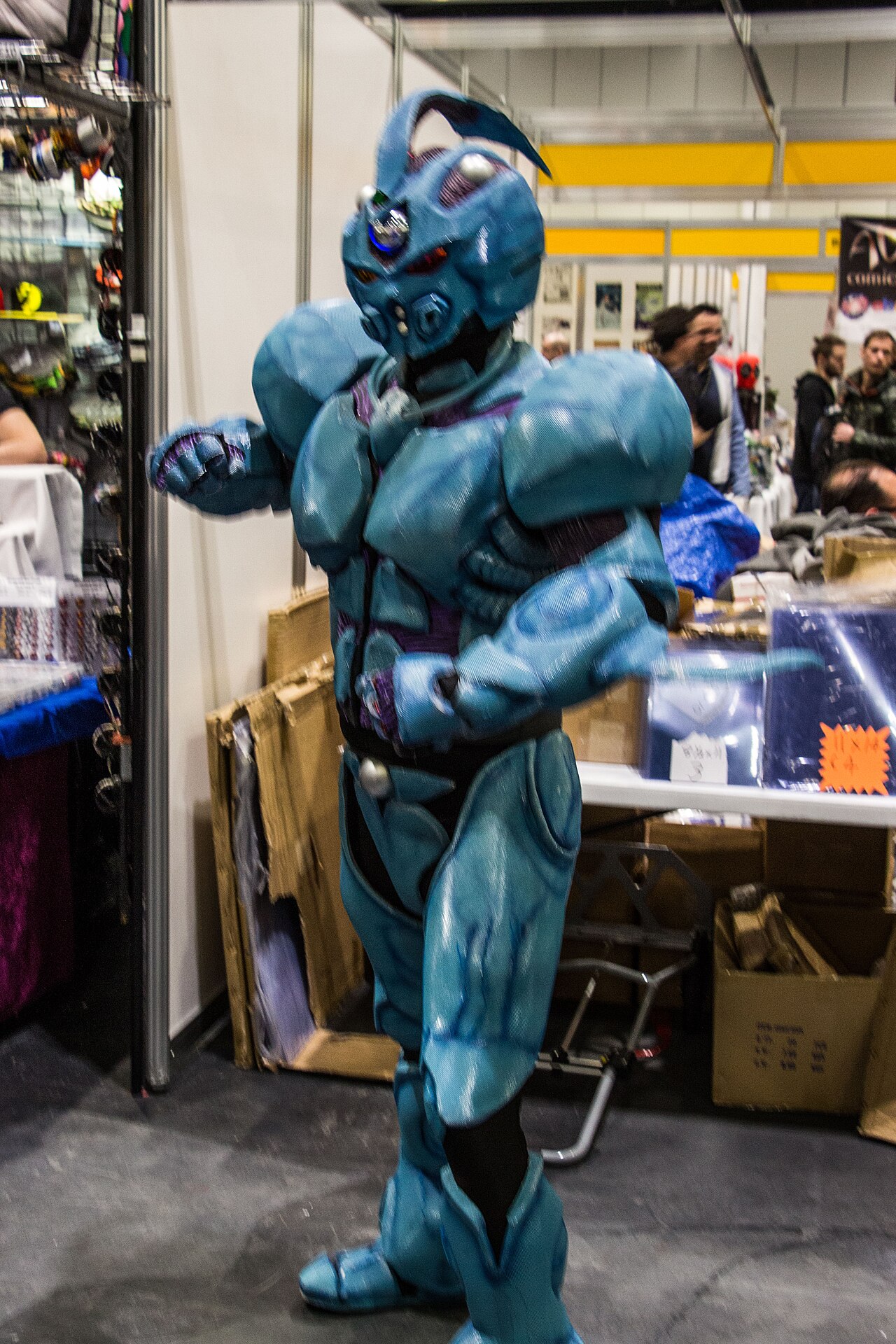
Secondgardener · CC BY-SA 4.0
Bio-Booster Armor Guyver, also called simply Guyver, is a manga by Yoshiki Takaya. The Guyver is a symbiotic, techno-organic device that boosts its host's abilities. The manga first ran in Tokuma Shoten's Monthly Shōnen Captain from February 1985 until that magazine ended in 1997. It then moved to Kadokawa Shoten's Monthly Ace Next from 1999 until that magazine stopped in April 2002. Since February 2007, it has been published irregularly in Kadokawa's Monthly Shōnen Ace, with the most recent chapter appearing in June 2016, after which the series went on indefinite hiatus. Viz Media, Star Comics, and Chuang Yi Publishing have licensed it. Adaptations include a single OVA, *Guyver: Out of Control* (1986, loosely based on the first volume), a 12-episode OVA series (1989–1992, covering the first four volumes), two American live-action tokusatsu films (*The Guyver* in 1991 and *Guyver: Dark Hero* in 1994), and a 26-episode anime series (2005–2006, covering the first ten volumes). A novel came out in 1989, and two light novels were released in 1995.
A test-type Zoanoid escapes from the Cronos Corporation carrying three Guyver Units. Cronos soldiers chase him into woods to recover the units, but when cornered, he detonates a bomb he had. The blast scatters the units. One unit, "Unit I," lands near two high school students, Shō Fukamachi and Tetsurō Segawa. Cronos retrieves the second unit, which later merges with Oswald A. Lisker to become the second Guyver. The third unit ends up with Agito Makishima, who merges with it at an unknown time. Shō accidentally activates his unit, which painfully merges with him. Over time, Shō learns about the Guyver and its powers. The armor is nearly invulnerable, with its only weak point being the Control Metal. If that part stays intact, the Guyver can rebuild the host from stored data, but if it is critically damaged, the unit consumes the host alive, killing them. This disturbs Shō, who wonders if he can ever be free of the Guyver. The situation worsens as Cronos sends increasingly powerful Zoanoids to retrieve the unit, making it hard for Shō to protect his friends. Later, the story takes a sharp turn: Cronos succeeds in taking over the world and reshaping it to its ideals.
Quick Facts
- Ja Romaji
- Kyōshoku Sōkō Gaibā
Facts from the source article.
Lore & Background
The story begins when a test-type Zoanoid escapes from the Cronos Corporation with three Guyver Units. Cronos soldiers pursue him into woods, but he detonates a bomb, scattering the units. One unit, Unit I, lands near high school students Shō Fukamachi and Tetsurō Segawa. Shō accidentally activates the unit, which painfully merges with him. The second unit is retrieved by Cronos and merges with Oswald A. Lisker to become the second Guyver. The third unit falls into the hands of Agito Makishima, who merges with it later. The Guyver is virtually invulnerable, with its only weak point being the Control Metal. If intact, it can rebuild the host from stored data; if critically damaged, the host is eaten alive by the unit. Cronos continuously sends more powerful Zoanoids to retrieve the Guyver. As the story progresses, Cronos succeeds in taking over the world and reshaping it according to its ideals, labeling the Guyvers as a 'vanguard of alien invaders' to the public.
Reader's Guide
The series is notable for its long-running manga serialization spanning over three decades, though it has been on indefinite hiatus since 2016. It originated in Monthly Shōnen Captain from 1985 until that magazine's discontinuation in 1997, then moved to Monthly Ace Next from 1999 until its discontinuation in 2002, and finally to Monthly Shōnen Ace from 2007. The manga has been licensed in English by Viz Media, Star Comics, and Chuang Yi Publishing. Its adaptations include a 1986 OVA, a 12-episode OVA series from 1989 to 1992, two American live-action tokusatsu films (1991 and 1994), and a 26-episode anime series from 2005 to 2006. The series also produced a novel in 1989 and two light novels in 1995. The plot explores themes of body horror, conspiracy, and resistance, as the protagonist Shō Fukamachi fights to protect his friends and family from the Cronos Corporation while grappling with the Guyver's dangerous symbiotic nature.
Did You Know?
- The Guyver unit's only weak point is the Control Metal; if critically damaged, the host is eaten alive by the unit.
- Aptom can regenerate himself even from the smallest remaining piece of his tissue and can clone himself, each clone having its own consciousness.
- The manga was serialized in three different magazines over its run, moving after each magazine's discontinuation.
A Decades-Long Publication Odyssey
Yoshiki Takaya's manga began its long journey in February 1985 within Tokuma Shoten's Monthly Shōnen Captain, running for nearly twelve years until that magazine's discontinuation in January 1997. Rather than ending, the series found a new home at Kadokawa Shoten, where it appeared in Monthly Ace Next from 1999 through April 2002. After another gap, Takaya returned to serialization in Kadokawa's Monthly Shōnen Ace starting in February 2007, though the pace proved irregular. The most recent chapter dropped in June 2016, after which the story entered an indefinite hiatus. Despite these interruptions and publisher changes, the work managed to attract international licensing deals with Viz Media, Star Comics, and Chuang Yi Publishing, ensuring readers outside Japan could follow the saga. The sheer span of over three decades of on-and-off publication makes Guyver one of the more unusual long-running manga titles, its story stretching across multiple editorial eras and magazine formats without ever reaching a definitive conclusion.
The Symbiotic Device and Its Cruel Bargain
At the heart of the series lies a concept that blurs the boundary between technology and biology: the Guyver is a symbiotic techno-organic device, sometimes described as biomechanical, that fuses with a human host and dramatically amplifies their physical capabilities. Once merged, the armor renders its wearer virtually invulnerable in combat. Yet this power carries a terrifying cost. The unit's sole vulnerability is a component called the Control Metal. As long as that part remains intact, the Guyver can reconstruct its host from biological data stored within the device. However, if the Control Metal suffers critical damage, the unit devours its host alive, leaving no survivor. For Shō Fukamachi, this creates an existential dread that shadows every battle. He must fight to protect the people he loves while simultaneously wondering whether he will ever be freed from the entity bonded to his body. The Guyver is both salvation and sentence, and that duality drives the emotional core of the narrative.
A Property Across Every Medium
Guyver's reach extends far beyond the printed page. The first adaptation was a single OVA titled Guyver: Out of Control, released in 1986 and loosely based on the manga's first volume. A more substantial 12-episode anime OVA series followed between 1989 and 1992, adapting the first four volumes. The property also crossed into live-action territory with two American tokusatsu films: The Guyver in 1991 and Guyver: Dark Hero in 1994. In 2005, a 26-episode television anime series aired, covering the first ten volumes of the manga. Beyond animation and film, the franchise expanded into prose with a novel published in 1989 and two light novels released in 1995. This breadth of adaptation—spanning OVA, television anime, live-action tokusatsu, novels, and light novels—demonstrates how the core concept of a human merged with a living armor resonated across multiple creative formats and audiences during the late 1980s and 1990s.
From Personal Defense to Global Conquest
The story's scope expands dramatically as the narrative progresses. Initially, Shō fights to shield his friends and family from Cronos soldiers and the Zoanoids they deploy. But Cronos escalates relentlessly, sending ever more powerful creatures to reclaim the lost Guyver Units. The conflict eventually reaches a staggering turning point: Cronos succeeds in seizing control of the entire world and reshaping society according to its own vision. In this new order, the Guyvers are publicly branded as a vanguard of alien invaders, turning their hosts into hunted outcasts. Agito Makishima, the calculating anti-hero known as Guyver III, channels his fury into leading a resistance called Zeus No Ikazuchi, named for the myth of Zeus overthrowing his father Cronos. His devoted servant Shizu Onuma, transformed into the proto-zoalord Griselda, protects the organization's members from Cronos' psychic domination, though the transformation has severely shortened her lifespan. Meanwhile, Shō's own father Fumio is captured and weaponized into a Guyver-hunting Zoanoid, forcing Shō into a devastating confrontation with his own blood.
Gallery


Frequently Asked Questions
What is Bio Booster Armor Guyver?
It is a symbiotic techno-organic suit of armor that permanently bonds with a human host, vastly amplifying their physical capabilities. The concept was created by manga artist Yoshiki Takaya, with the story debuting in February 1985.
What powers does the Guyver armor grant its wearer?
The armor fuses with the host's body to supercharge their strength, speed, and durability while also enabling energy-based offensive attacks. It effectively turns the wearer into a heavily augmented combatant with regenerative resilience.
Why is Bio Booster Armor Guyver considered important in the genre?
It is widely regarded as one of the earliest and most influential works in the Japanese cyberpunk-biomech subgenre. Its core premise of a living armor merging with a human host inspired numerous later series exploring similar techno-organic themes.
Who publishes Bio Booster Armor Guyver and where can English readers find it?
The original manga was serialized by Tokuma Shoten and later Kadokawa Shoten in Japan. English-language editions have been licensed by Viz Media, Star Comics, and Chuang Yi Publishing.
More in Television Series About Genetic Engineering 1-23
Spotted an error? Know more?
Reader corrections go straight into our review queue. Suggest an edit · How this site is sourced