Frequently Asked Questions
The most-asked questions about telegraph keys and codes.
What exactly is a telegraph key?
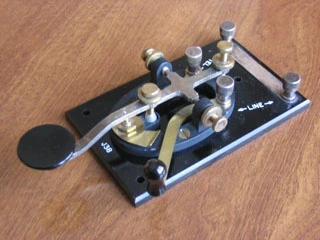
A telegraph key is a hand-operated switch that opens and closes an electrical circuit to produce the short and long pulses of Morse code. It typically consists of a lever or paddle mounted on a base, connected to a contact point that completes the circuit when pressed.
Who are the key historical figures behind telegraph keys and codes?
Samuel Morse and Alfred Vail are most credited with developing the practical telegraph system and its dot-dash code in the 1830s and 1840s. Other notable contributors include William Cooke and Charles Wheatstone in Britain, and later inventors who refined key designs such as the straight key and semi-automatic keys.
What is Morse code and how is it structured?
Morse code is a signaling system in which each letter, number, and punctuation mark is represented by a unique sequence of short marks (dots) and long marks (dashes). Standardized timing intervals between elements, letters, and words keep the code readable even at high speed.
What are the main types of telegraph keys a beginner should know?
The three most common categories are the straight key (a simple on/off lever), the semi-automatic key or 'bug' (which mechanically repeats dots or dashes), and the full-automatic key or 'Vibroplex' (which repeats both). Each type changes how much physical effort the operator must supply to sustain a signal.
What is the International Telegraph Alphabet and how does it differ from Morse?
The ITA, also called Baudot code, is a five-bit encoding system that assigns a fixed five-symbol pattern to each character, unlike Morse's variable-length dot-dash sequences. It was designed for teleprinter machines and later evolved into the ITA-2 and ITA-5 standards used in early telex and teletype networks.
Where should a newcomer start if they want to learn telegraph key operation?
A good first step is practicing on a simple straight key with a practice set—a loop of wire, a small battery, and a buzzer or earphone—to build a feel for timing. Many enthusiasts also begin with online Morse code trainers before moving to physical keying to develop hand speed and consistency.
What is a straight key and why is it considered the classic design?
A straight key is the simplest telegraph key: a single lever that the operator taps to make and break the circuit, producing both dots and dashes entirely by hand. It dates back to the earliest commercial telegraph lines and remains the standard for learning and for CW (continuous wave) amateur radio operation.
What are some notable historical milestones in telegraph key and code development?
The 1844 'What hath God wrought' message marked the first public demonstration of the American telegraph line. The 1866 laying of the transatlantic cable proved long-distance keying was viable, and the mid-1860s saw the formalization of the International Morse Code by the International Telegraph Union.
How does a semi-automatic key (a 'bug') differ from a straight key in practice?
A bug uses a small mechanical lever or spring to automatically repeat dots or dashes once the operator engages the appropriate side, reducing finger fatigue during long transmissions. The operator still controls rhythm and spacing, but the repetitive tapping is handled by the mechanism.
What materials and components make up a typical telegraph key?
Most keys are built from a wooden or metal base plate, a brass or steel lever arm, a felt or rubber cushion, and a set of electrical contacts (often brass or silver) that bridge when the lever is pressed. Spring tension and contact gap are usually adjustable to suit the operator's preferred feel and speed.