Trembleuse
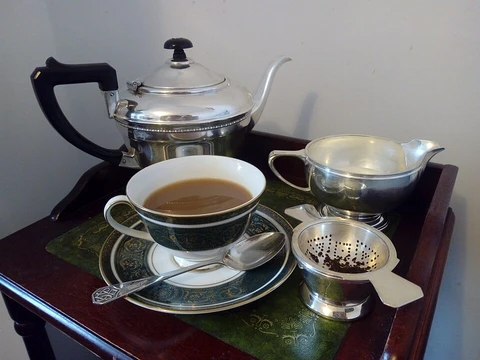
A cup and saucer designed for stability, aiding those with trembling hands.
Last updated
A trembleuse is a drinking cup and saucer designed with a raised gallery or recessed well in the saucer to hold the cup more securely than a standard saucer. This type of teaware, also called a tasse trembleuse or chocolate cup, is notable for its specialized construction that provides stability for the cup, often made of porcelain or bone china, with saucers sometimes crafted in silver or gold.
Quick Facts
- Alternative names
- tasse trembleuse
- chocolate cup
- gobelet et soucoupe enfoncé
- Materials
- porcelain
- bone china
- creamware
- silver
- gold
- Notable example
- Vienna porcelain set (1735-40) with tray
- cup
- water glass
- gold galleries
- and lapis lazuli plaque
- Depicted in
- The Chocolate Girl (Das Schokoladenmadchen) by Jean-Étienne Liotard (c. 1743)
Facts from the source article.
Usage
Trembleuse cups allowed individuals with a weak grip or trembling hands to drink tea or hot chocolate, though whether this was the original design intent is uncertain. Cups could have no handles or two handles, and sometimes included a lid; the raised gallery of the saucer was often openwork. Cups intended for galleries typically had a flat but narrower base than standard tea or coffee cups. These items were usually sold singly or in pairs rather than in larger sets, with the proliferation of specialized porcelain shapes encouraged by porcelain companies catering to fashionable customers.
A lavish Vienna porcelain set from 1735-40 includes a small tray holding a matching cup and water glass, both with gold galleries and covers, and a vertical gold shell shape for a spoon set in a lapis lazuli plaque, described as an 'ensemble for chocolate' by the Metropolitan Museum of Art. The well-known pastel The Chocolate Girl by Jean-Étienne Liotard shows a maid carrying a tray with a Meissen trembleuse featuring a silver gallery and a plain glass of water; such a matching porcelain tray is called a présentoire.
The name 'trembleuse' is generally considered 19th-century or later; in the 18th century, manufacturers used various names. Sèvres catalogues from 1759 used 'Gobelet et soucoupe enfoncé' for a saucer with a well, as well as 'tasses à toilette et sou-coupes'. Meissen used 'Schokoladetassen', Vienna used 'Schokoladebecher mit Einsatztasse', and Höchst Porcelain used 'Kronenschale'. However, Sèvres records from the 1750s and 1760s also refer to a 'Gobelet et soucoupe trembleuse', which Adrian Sassoon suggests may refer to a different rare type of deep saucer with three large concave lobes and divisions that form buttresses to hold the cup.
Origins
For centuries, Chinese ceramics, like Song dynasty Ru ware, featured saucers with raised rims, often called cup stands, many with an open-bottomed well. When tea became popular in the Ottoman Empire, the zarf, a cup-holder similar to a large eggcup, emerged to hold small Chinese export tea-bowls. It is uncertain whether these Chinese or Turkish forms influenced the trembleuse. This European vessel first appeared in Paris during the 1690s, linked to drinking chocolate rather than tea or coffee, and may have been shaped more by the Hispanic mancerina than by Asian designs.
Mancerina
The trembleuse originated in Spain, typically made for a small cup without a handle. It may have been the first Western form of its kind, introduced or named for Pedro de Toledo, the 1st Marquis of Mancera, during his mid-17th-century term as Viceroy of Peru.
Its main use was for drinking chocolate. In South America, Spanish colonists took up the indigenous practice of consuming chocolate hot, strong, and bitter in tiny cups fashioned from dried gourds or pottery imitating that shape. Because those cups lacked a steady base—a problem for the Spanish—the galleried saucer was created to secure them.
More in Teaware
Sources
Compiled from Wikipedia and the sources listed below. Text from Wikipedia is available under CC BY-SA 4.0; this entry is adapted from it.
- Wikipedia: Trembleuse (CC BY-SA 4.0).
Spotted an error? Know more?
Reader corrections go straight into our review queue. Suggest an edit · How this site is sourced