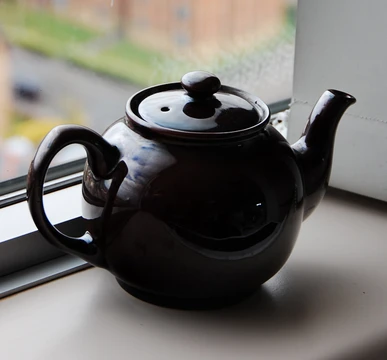
Russell's teapot
Analogy about burden of proof for unfalsifiable claims.
Russell's teapot is an analogy devised by the philosopher Bertrand Russell to argue that the burden of proof rests on those making empirically unfalsifiable claims, not on others to disprove them. Russell applied the analogy to religion, suggesting that an assertion about an undetectable teapot orbiting the Sun should not be believed simply because it cannot be proven false. The analogy has been criticized by several philosophers regarding its applicability to religion and has inspired similar analogies and parodies.
Quick Facts
- Philosopher
- Bertrand Russell
- Lifespan
- 1872–1970
- Context
- Religion
- Critics
- Brian Garvey
- Peter van Inwagen
- Alvin Plantinga
Facts from the source article.
Did You Know?
- The concept of Russell's teapot has influenced the Invisible Pink Unicorn and the Flying Spaghetti Monster.
- Daevid Allen refers to Russell's teapot in his book Gong Dreaming 2: The Histories & Mysteries of Gong from 1969–1975.
Analysis
Chemist Peter Atkins stated that the point of Russell's teapot is that no one bears a burden to disprove assertions. Occam's razor has been interpreted to mean that the simpler theory with fewer assertions, such as a universe without supernatural beings, should be the starting point in discussion rather than the more complex theory. Philosopher Paul Chamberlain responded to biologist Richard Dawkins' use of the celestial teapot as evidence against religion by arguing that such arguments rely on an undue distinction between positive and negative claims. Chamberlain asserted that it is logically erroneous to claim that positive truth claims bear a burden of proof while negative truth claims do not, stating that every truth claim, whether positive or negative, has a burden of proof. Dawkins used the teapot in his books A Devil's Chaplain and The God Delusion as an analogy against what he termed agnostic conciliation, a policy of intellectual appeasement that allows for philosophical domains concerning exclusively religious matters. Dawkins presented the teapot as a reductio ad absurdum of the position that agnosticism demands equal respect for belief and disbelief in a supreme being, arguing that if so, it must also give equal respect to belief in an orbiting teapot, since its existence is just as plausible scientifically. Philosopher Brian Garvey argued that the teapot analogy fails regarding religion because with the teapot, the believer and non-believer disagree about one item in the universe and may hold all other beliefs in common, which is not true of an atheist and a theist. Garvey stated that the atheist is not merely denying an existence the theist affirms but is also committed to the view that the universe is not the way it is because of God, either being the way it is because of something else or having no reason for being that way.
Similar analogies
Other thinkers have proposed non-disprovable analogies. J. B. Bury wrote in his 1913 book History of Freedom of Thought that the burden of proof does not lie upon the rejecter, using the example of a race of donkeys on a planet revolving around Sirius that speak English and discuss eugenics, which could not be disproved but would have no claim to be believed. Astronomer Carl Sagan offered a similar analogy called the Dragon in the Garage in his 1995 book The Demon-Haunted World as an example of skeptical thinking, questioning the difference between an invisible, incorporeal, floating dragon that spits heatless fire and no dragon at all if there is no way to disprove its existence.
More in Teapots
Spotted an error? Know more?
Reader corrections go straight into our review queue. Suggest an edit · How this site is sourced