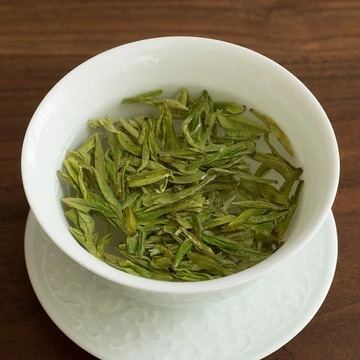
Green tea
A delicate, unoxidized tea with ancient origins in China.
Last updated
Green tea comes from the leaves and buds of the Camellia sinensis plant, but unlike oolong or black teas, it skips the withering and oxidation steps. Its origins trace back to China around the late 1st millennium BC, and cultivation later spread across East Asia. There are many types of green tea, shaped by the specific C. sinensis variety, where it’s grown, how it’s cultivated, the processing method, and when it’s harvested. While it might cause a slight drop in blood pressure and boost alertness, drinking green tea doesn’t produce health benefits.
History
However, taking too much green tea extract can harm the liver, interfere with prescription medications, and cause stomach upset. Legend says tea drinking began in China under the mythical Emperor Shennong. A key historical text is The Classic of Tea, written by Lu Yu between 618 and 907 AD. Another important work, The Book of Tea (or Kissa Yōjōki), was penned by the Zen priest Eisai in 1211; it discusses how green tea affects five vital organs, describes the plant’s shape and leaves, and explains growing and processing methods.
Steeping, brewing and serving
Brewing green tea typically uses 2 grams of leaves per 100 milliliters of water (roughly one teaspoon per 150-milliliter cup). Water temperature ranges from 61°C to 87°C, and steeping time varies from 30 seconds to three minutes. Lower-quality teas generally need hotter water and longer steeping, while higher-quality teas are steeped at cooler temperatures for shorter periods—often two or three times.
Premium teas like gyokuro require more leaves and multiple short steeps. If the water is too hot or the steeping too long, too many tannins are released, making the brew bitter and astringent regardless of leaf quality. Technique matters: warming the steeping container beforehand prevents rapid cooling, and leaving the leaves in the pot while gradually adding hot water during drinking also affects flavor. In 2013, global green tea production reached about 1.7 million tonnes, with predictions it would double by 2023.
Growing, harvesting and processing
By 2015, China supplied 80% of the world’s green tea, with exports rising 9% annually to 325,000 tonnes that year. The United States was the biggest importer of Chinese green tea in 2015 (6,800 tonnes, up 10% from 2014), followed by Britain (1,900 tonnes, up 15%). How green tea is grown and processed depends on the desired type, but the goal is to retain maximum polyphenols and volatile organic compounds, which affect aroma and taste. Plants are either sun-grown or shade-grown, pruned into rows to encourage regular shoot growth, and typically harvested three times a year: the first flush in late April to early May, the second from June to July, and the third from late July to early August (sometimes a fourth harvest occurs).
The spring first flush yields the best-quality leaves and commands higher prices. After picking, processing can be artisanal (sun-drying, basket or charcoal firing, pan-firing) or modern (oven-drying, tumbling, steaming). The resulting crude tea, called aracha, is stored in 30- or 60-kilogram paper bags under low-humidity refrigeration at 0–5°C. At this stage, it hasn’t been refined; a final firing happens before blending, selection, and packaging.
Import of radioactive Japanese tea
Leaves are re-fired throughout the year as needed, extending shelf life and improving flavor. First-flush tea from May can be stored this way until the next year’s harvest. After re-drying, the crude tea is sifted and graded by size, then blended according to tasters’ orders and packed for sale. On June 17, 2011, at Charles de Gaulle Airport in Paris, French authorities detected radioactive cesium at 1,038 becquerels per kilogram in tea leaves imported from Shizuoka Prefecture, Japan—more than double the European Union’s limit of 500 becquerels per kilogram.
France rejected the shipment, which totaled 162 kilograms. Shizuoka’s governor, Heita Kawakatsu, responded that drinking the tea posed no risk because steeping would dilute the radioactivity to about 10 becquerels per kilogram, even if the leaves contained 1,000 becquerels per kilogram—a claim backed by local tests. Japan’s Minister for Consumer Affairs and Food Safety, Renhō, stated on June 3, 2011, that because aracha is sometimes sold as furikake and eaten directly, inspecting tea leaves (including aracha) was important for consumer safety. In 2018, the U.S. Food and Drug Administration updated its guidance on the matter.
Lore & Background
Tea consumption has its legendary origins in China during the reign of mythological Emperor Shennong. A book written by Lu Yu in 618–907 AD, The Classic of Tea, is considered important in green tea history. The Book of Tea (Kissa Yōjōki), written by Zen priest Eisai in 1211, describes how drinking green tea may affect five vital organs, the shapes of tea plants, flowers and leaves, and how to grow and process tea leaves.
Reader's Guide
Steeping, or brewing, is the process of making tea from leaves and hot water, generally using 2 g of tea per 100 mL of water. Steeping temperatures range from 61°C to 87°C and steeping times from 30 seconds to three minutes.
Lower-quality green teas are steeped hotter and longer while higher-quality teas are steeped cooler and shorter, but usually multiple times (2–3 typically). Steeping too hot or too long results in the release of excessive amounts of tannins, leading to a bitter, astringent brew. Two important techniques are to warm the steeping container beforehand and to leave the tea leaves in the pot and gradually add more hot water during consumption.
Did You Know?
- Several varieties of green tea exist, which differ substantially based on the variety of C. sinensis used, growing conditions, horticultural methods, production processing, and time of harvest.
- While it may slightly lower blood pressure and improve alertness, consuming green tea does not provide health effects.
More in Tea
Sources
Compiled from Wikipedia and the sources listed below. Text from Wikipedia is available under CC BY-SA 4.0; this entry is adapted from it.
- Wikipedia: Green tea (CC BY-SA 4.0).
Spotted an error? Know more?
Reader corrections go straight into our review queue. Suggest an edit · How this site is sourced