Compressed tea
Pressed tea blocks used for drinking, eating, and currency.
Last updated
Compressed tea, also known as tea bricks, cakes, lumps, or nuggets, consists of whole or ground tea leaves pressed into solid blocks. It was the dominant form of tea in ancient China before the Ming Dynasty and remains common for post-fermented teas like pu-erh, while historically serving as a form of currency.
Quick Facts
- Standard dome-shaped nugget weight
- 100 g
- Small dome-shaped nugget weight
- 3 g–5 g
- Large disc weight
- 357 g
- Tangka weight
- about 5.4 grams
Facts from the source article.
Production
In ancient China, compressed teas were typically made from thoroughly dried and ground tea leaves pressed into bricks or other shapes, though partially dried and whole leaves were also employed. Some bricks incorporated binding agents such as flour, blood, or manure to maintain their form, especially when intended for use as currency. After pressing, the bricks were left to cure, dry, and age before sale or trade. Prior to the 19th century, tea bricks were favored in Asian trade because they were more compact and less prone to damage than loose leaf tea, an advantage during overland transport by caravans on the Tea Horse Road.
Modern production of compressed teas continues for drinking, as with pu-erh, and for souvenirs, though most contemporary bricks are made from whole leaves. Various traditional shapes persist: a dome-shaped nugget of 100 g is called tuóchá (沱茶), sometimes translated as 'bird's nest tea' or 'bowl tea'; a smaller version weighing 3 g–5 g is xiǎo tuóchá (小沱茶); a disc of about 357 g with a dimple is bǐngchá (饼茶, 'biscuit tea' or 'cake tea'); and a large flat square brick is fāngchá (方茶, 'square tea').
To produce a brick, ground or whole tea is first steamed, then compressed in a press, which may leave an artistic design or cloth pattern. Many powdered bricks are moistened with rice water to help the powder adhere, and the pressed blocks are dried in storage until the desired moisture level is reached.
Consumption
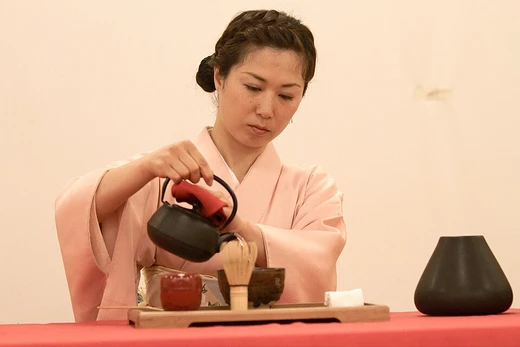
Because of their density and toughness, tea bricks were broken into small pieces and boiled. During the Tang Dynasty, they were ground to a fine powder before consumption; this legacy persists in modern Japanese matcha and in the pulverized leaves used in lei cha by the Hakka people and some in Hunan province. In modern times, pu-erh bricks are flaked, chipped, or broken and steeped after thorough rinsing, making the toasting, grinding, and whisking process uncommon.
In pre-modern Korea, pressed tea called tteokcha (also byeongcha) was widely produced and consumed; a coin-shaped variety with a hole was known as doncha, jeoncha, or cheongtaejeon, and Borim-cha (or Borim-baengmo-cha) from Borim temple in Jangheung, South Jeolla Province, is a popular type. In parts of Central Asia and Tibet, tea bricks are used as food: pieces are broken off, boiled overnight in water sometimes with salt, and the concentrated infusion is mixed with butter, cream, or milk and salt to make butter tea.
The tea mixed with tsampa is called Pah, and individual portions are kneaded in a bowl, formed into balls, and eaten. In some cities of Fukui prefecture in Japan, concentrated tea is mixed with grain flour in a similar fashion, though the tea may or may not come from bricks.
Use as currency
Tea bricks served as a form of currency throughout China, Tibet, Mongolia, and Central Asia, analogous to the use of salt bricks in parts of Africa. Nomads of Mongolia and Siberia preferred tea bricks over metallic coins, as the bricks could be used as money, eaten in times of hunger, or brewed as a medicine for coughs and colds. Until World War II, tea bricks remained an edible currency in Siberia.
For Tibet, bricks were mainly produced in Ya'an in Sichuan province, in five qualities. The third-quality brick, called brgyad pa ('eighth') by Tibetans, was most commonly used as currency in the late 19th and early 20th centuries, worth eight Tibetan tangkas (standard silver coin of about 5.4 grams) in Lhasa. These bricks were also exported from Tibet to Bhutan and Ladakh.
Did You Know?
- Tea bricks made from old leaves and stems can accumulate high levels of fluoride, leading to fluorosis in areas of high consumption such as Tibet.
- The color and patterns formed by powdered tea in hot water were enjoyed while the mixture was being drunk.
More in Tea Culture
Sources
Compiled from Wikipedia and the sources listed below. Text from Wikipedia is available under CC BY-SA 4.0; this entry is adapted from it.
- Wikipedia: Compressed tea (CC BY-SA 4.0).
Spotted an error? Know more?
Reader corrections go straight into our review queue. Suggest an edit · How this site is sourced