Wang Chongyang
Founder of the Quanzhen school of Taoism.

via Wikipedia: Wang Chongyang · see source
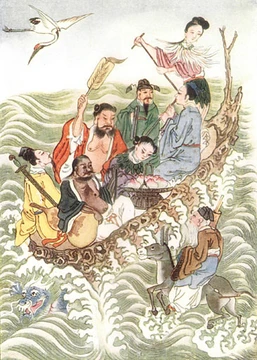
Wang Chongyang (11 January 1113 – 22 January 1170) founded the Quanzhen school of Taoism and is counted among its Five Northern Patriarchs, alongside Wang Xuanfu, Zhongli Quan, Lü Dongbin, and Liu Haichan. He also appears among the Eight Immortals. Though he attracted many followers, he formally accepted only seven major disciples: Ma Danyang, Qiu Chuji, Tan Chuduan, Liu Chuxuan, Hao Datong, Wang Chuyi, and Sun Bu'er. These seven are known as the Seven Perfected or the Seven Masters of Quanzhen.
Quick Facts
- Religion
- Taoism
- School
- Quanzhen School
- Known for
- Founder of Quanzhen School
- Other names
- Wang Zhe
- Monastic name
- Chongyang
- Birth name
- Wang Zhongfu
- Born
- 11 January 1113
- Birthplace
- Jingzhao Xianyang, Song Empire
Facts from the source article.
Life
Wang Chongyang was born with his birth name as 'Zhongfu' in a wealthy family in 1113. He was educated in Chinese classics and martial arts. His family had been a prominent local clan for generations. He loved reading from a young age, later entered the prefectural school, and passed the imperial examination.
In the early years of Emperor Xizong of Jin's Tianjuan era (1138-1140), he took the military examination, passed the first-class examination category, and became the top scholar in the military examinations. He then changed his name to Dewei, with the courtesy name Shixiong. Later, despite having achieved top honours in both civil and military examinations, he served as a minor official in charge of collecting wine for a long time. Then he resigned and withdrew to his home, spending his days numbing himself with alcohol.
According to tradition, in the summer of 1159 when he was 48, he met two Taoist immortals in a tavern in Ganhe Town, Zhongnan, Shaanxi, Zhongli Quan and Lü Dongbin. They taught him the true secrets of Taoist cultivation. He changed his name to 'Zhe' and adopted the Taoist name 'Chongyang'. Wang Chongyang needed a place to conduct his cultivation so he dug up a tomb at the eastern edge of his village near Mount Zhongnan, and called it the 'Tomb of the Living Dead'.
This tomb 'was a mound of dirt several feet high, with a ten-foot-high ceiling dug under it. Near the entrance to this underground enclosure Wang placed a plaque that read, "Wang Haifeng" (Lunatic Wang).' He stayed here for three years during which he became an immortal and attained the Tao. After three years, the two immortals came again and instructed him to spread the Tao and save the people.
In particular they ordered him to go to Shandong and find Qiu, Liu, Tan and Ma. Therefore, in the seventh year of the Dading era of Jin dynasty (1167), Wang Chongyang burnt down his thatched hut and left Shaanxi to journey east to Shandong to carry out his mission. When he arrived in Ninghai, Shandong, he first found Ma Danyang, which was married with Sun Bu'er. Ma recognized immediately Wang Chongyang as an immortal and became his disciple.
Ma Danyang ordered the construction of a hut in the garden of his mansion where his master went to reside and conduct his practice. This hut was called by Wang Chongyang 'Quanzhen Hut' (全真庵 Quanzhen an)—this is where the name of the Quanzhen school comes from. Soon after, Sun Bu'er also recognized him as her master; so she departed to carry on her cultivation in seclusion, following the instructions of the female internal alchemy handed by Wang Chongyang.
In the ninth month of 1167 Qiu Chuji arrived at the Quanzhen Hut. Nineteen years old at the time, he had heard that an immortal was residing in the Ma family's mansion so he hurried to meet him and became his disciple. Later Tan Chuduan, Liu Chuxuan, Wang Chuyi and Hao Datong also became his disciples. During these years, Wang Chongyang established five congregations in Shandong: Three Teachings Seven Treasures Congregation (August 1168 at Jiang Bao'an Temple in Wendeng), Three Teachings Golden Lotus Congregation (April 1169 at the 'Golden Lotus Hall' in Ninghai), Three Teachings Three Lights Congregation (September 1169 in Fushan County), Three Teachings Equality Congregation (1169 in Dengzhou, present-day Penglai), and Three Teachings Jade Flower Congregation (the last one, in Laizhou).
Collectively known as the 'Three Prefectures and Five Congregations', they were mass religious organizations established by Wang Chongyang during his time in Shandong to promote the Quanzhen school of Taoism. These congregations were characterized by the common name of 'Three Teachings' (三教 Sanjiao), as Wang promoted the synthesis of the Three Teachings of Taoism, Buddhism, and Confucianism. In the ninth year of the Dading era of Jin dynasty (1169), Wang Chongyang returned westward with his disciples Ma, Tan, Liu, and Qiu.
He died in Daliang (now Kaifeng, Henan) a few months later, on January 22, 1170 (the fourth day of the first month of the tenth year of the Dading era of the Jin dynasty), at the age of 58. The four disciples Ma, Tan, Liu, and Qiu carried his coffin to his former residence in Liujiang Village, Zhongnan Mountain (present-day Zu'an Town, Huyi County, Xi'an City, Shaanxi), where they conducted the burial and funeral rites. The Quanzhen School revered this place as the Ancestral Hut (祖庵 Zu'an).
The four disciples stayed here together for three years, after that they parted way, each one carrying on his own cultivation. The Ancestral Hut where Wang Chongyang was buried is now Chongyang Palace, which attracts visitors and believers worldwide. In the sixth year of the Yuan dynasty's Zhiyuan era, he was posthumously honored as 'True Lord, Enlightener of the Complete True Nature, Chongyang' (重阳全真开化真君 Chongyang Quanzhen Kaihua Zhenjun). In the third year of the Yuan dynasty's Zhida era (1310), he was further honored as 'Emperor of the Assisting Pole, Enlightener of the Complete True Nature, Chongyang' (重阳全真开化辅极帝君 Chongyang Quanzhen Kaihua Fuji Dijun).
Teaching
Wang Chongyang advocated the cultivation of internal alchemy (内丹 neidan) through which the practitioners take their own body as the cauldron to refine the internal elixir and transcend the mundane. Wang Chongyang promoted the unity of the Three Teachings (Confucianism, Taoism, and Buddhism), so the practitioners had to study the Tao Te Ching, the Classic of Filial Piety and the Heart Sutra. The inner alchemy practice is accompanied by the cultivation of one's character in the world.
To accumulate merits and deeds is of paramount importance to attain the Tao. This is done through filial piety, helping people, and basically by being a good human. To practice does not just mean sitting with closed eyes, but rather being constantly observant of the heart-mind while sitting, standing, lying and walking, so that it becomes like Mount Tai, still and clear. This is possible only by reducing one's emotions and desires.
Wang Chongyang advocated monastic life and cultivation in seclusion, promoting the monastic community of Taoist priests residing in temples: this was a major characteristic of the early Quanzhen school. All those who wished to renounce their worldly life were invited to first reside in a hut. Because a hut is a dwelling, it provides a person with a place to rely on. When the body has something to rely on and support, the mind gradually becomes stable, and the qi and shen will harmonize and flow smoothly.
Wang Chongyang also valued group practice, suggesting that practitioners should 'have fellow practitioners,' but he had specific requirements for these companions. Wang Chongyang advocated eliminating worldly desires. He once told Ma Yu, 'Ordinary people entering the Dao must abstain from wine, women, wealth, anger, clinging to desires, and worries; there is no other remedy.' He believed that these would lead to depravity, confusion, and loss of spirit and vitality.
Therefore, one's lifestyle should be simple. He also taught his disciples to maintain inner peace, live a simple and natural life, and cultivate their innate nature and life-destiny. The cultivation of both innate nature and life-destiny (性命双修 xingming shuangxiu) is a characteristic of the Quanzhen school. In his Fifteen Essays to Establish the Teaching he says: 'Inner nature is shen, life-destiny is qi.
If innate nature meets life-destiny, it is like a bird catching the wind, soaring lightly, achieving success with little effort.' This shows that he considered both innate nature and life-destiny important in cultivation, mutually enhancing each other.
Writings
Wang was the author of many poems of Taoist instruction. According to legend, Liu Chuxuan became a follower of Wang after reading one of Wang's poems.
Frequently Asked Questions
When and where was Wang Chongyang born?
Wang Chongyang was born on 11 January 1113 in Jingzhao Xianyang, Song Empire.
When did Wang Chongyang die?
Wang Chongyang died on 22 January 1170 in Kaifeng, Jin Empire.
More in Taoist Immortals
Spotted an error? Know more?
Reader corrections go straight into our review queue. Suggest an edit · How this site is sourced