Frequently Asked Questions
The most-asked questions about tangs and surgeonfish.
What exactly are tangs and surgeonfish?
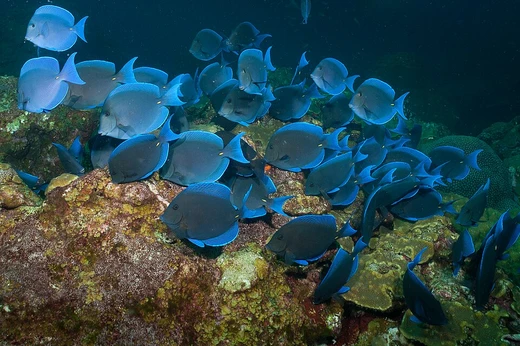
Tangs and surgeonfish are the common names for members of the marine family Acanthuridae, a group of laterally compressed, herbivorous reef fish found across tropical and subtropical oceans. The two terms are used interchangeably in most hobbyist and general-audience contexts, though some taxonomists reserve 'surgeonfish' for certain subgroups.
Why are they called 'surgeonfish'?
Every species in the family bears one or more sharp, blade-like spines on either side of the caudal peduncle that can be raised and sliced off as a defensive mechanism against predators. The spines resemble a medical scalpel, which is the origin of the 'surgeon' nickname.
What is the most well-known tang species?
The blue tang (Paracanthurus hepatus) is arguably the most recognizable, largely because its appearance was adapted into the character Dory in the animated film Finding Nemo. In the aquarium trade it is also sold under the trade name 'Pacifica' or 'regal blue tang.'
Where do tangs and surgeonfish live in the wild?
They are native to coral-reef environments throughout the Indo-Pacific, the Red Sea, and the eastern Atlantic (including the Canary Islands and West African coast). Most species occupy shallow lagoons, reef slopes, or open-water areas near hard substrates where algae grow.
What do tangs and surgeonfish eat?
They are primarily herbivorous grazers, scraping microalgae, diatoms, and detritus off rocks, coral rubble, and sand with their small, toothy mouths. In captivity they thrive on nori, spirulina-based pellets, and frozen seaweed mixes.
Are tangs and surgeonfish the same thing?
In everyday usage, yes—both names refer to the family Acanthuridae. Technically, some authors distinguish 'tangs' as the more elongated, open-water species (like the longhorn tang) from the shorter-bodied 'surgeonfish,' but the distinction is inconsistent and rarely followed in hobbyist literature.
How big do tangs and surgeonfish typically grow?
Most popular aquarium species reach roughly 5 to 10 inches (13–25 cm) at maturity, though some larger species such as the longhorn tang or the giant tang (Acanthurus giganteus) can exceed 20 inches. Adult size should always be factored into tank-size planning before purchase.
Are tangs and surgeonfish safe for a community reef tank?
Many species are peaceful, algae-grazing additions to established reef systems, but several are notably territorial—especially toward other tangs or similarly shaped fish. Keeping one tang per tank or choosing a species known for low aggression (like the yellow tang) reduces the risk of fin-nipping and stress.
What makes tangs and surgeonfish popular with reef-keeping hobbyists?
Their vivid, often high-contrast coloration, compact adult size, and effective algae-control role make them a staple of both display and functional reef aquariums. They are also relatively hardy once acclimated, tolerating a wide range of water parameters compared to more delicate reef species.
What is a notable behavioral trait of tangs and surgeonfish?
Many species perform a daily 'cleaning' behavior, using their mouth to scrape sediment and dead tissue from their own flanks, a habit that has led to the nickname 'self-cleaning fish' in some field guides. They are also known for rapid, darting escape bursts when startled, aided by their streamlined body and powerful caudal fin.