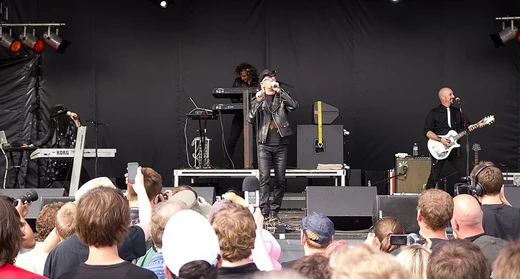
U škripcu
Yugoslav new wave band with theatrical live shows.
U škripcu (У шкрипцу; trans. In Dire Straits) was a Yugoslav rock band formed in Belgrade in 1980. The band initially gained attention as part of the Yugoslav new wave scene, known for artistic live performances. They achieved nationwide commercial success in the early 1980s with a New Romanticism-influenced sound before disbanding in 1985.
Quick Facts
- Origin
- Belgrade, SR Serbia, SFR Yugoslavia
- Genre
- New wave
- art rock
- post-punk
- synth-pop
- pop rock
- power pop
- Years active
- 1980–1985; 1986–1987; 1989–1991 (Reunions: 2006)
- Label
- Jugoton
- PGP-RTB
- Jugodisk
- Taped Pictures
- Automatik
- Croatia Records
Facts from the source article.
History
They first called themselves Prolog za veliki haos, then Furije furiozno furaju. All three worked as associate journalists for the Studio B radio show Mladi novi svet, later renamed Ritam srca; Delčić named the show and his voice appeared in its opening theme. In 1980, the group became U škripcu, a name chosen because they constantly struggled with broken equipment and little money. Drummer Miloš Obrenović joined, followed by bass guitarist Aleksandar Lukić. Early on, Delčić invented the “Pamflex” concept—an imaginary company whose products were advertised through the band’s songs. They called advertising the highest art form and brought theatre into their shows, delivering ironic speeches, playing accordion, and waving Pamflex flags. Their debut album, Godine ljubavi, came out on PGP-RTB in 1982. Lukić missed the recording because he was serving in the Yugoslav People’s Army; Idoli bassist Zdenko Kolar played bass on the album, and Dejan Grujić (formerly of Braća) handled bass during the promotional tour. For Godine ljubavi, the band formed a lasting team with producer Saša Habić and the Aux Maniere design group (Slobodan Šajin and Momčilo Rajin). The album’s songs touched on varied subjects, including “Ti imaš dosta godina,” “Hamuamule,” “Samuraj,” “Kao u boji,” and “Proleće.” In 1983, they signed with Jugoton and released the album O je! and the mini album Nove godine!. Critics and audiences welcomed O je! warmly, and Rock magazine named it the Best Release of 1983. With Lukić still away, Slobodan Svrdlan (from the heavy metal band Gordi) played bass and contributed arrangements; guests included Đorđe Petrović (keyboards), Nenad Jelić (percussion), and Jovan Maljoković (saxophone). “Beograd spava,” “Kockar,” and “Siđi do reke” received heavy radio play. The mini album Nove godine!, with cover art by Mirko Ilić, came out during the New Year holidays, and its title track plus “Koliko imaš godina” became national hits. Lukić returned in 1984, and the band toured extensively, mostly in SR Croatia. In 1985, they released Budimo zajedno!, which featured...
Legacy
A commemorative plaque for Delčić was placed on his former home in Belgrade’s Mila Jevtović Street in September 2013. In 2011, the Serbian alternative rock band Block Out put out two versions of the U škripcu song “Beograd spava” as a single. The following year, Croatian singer Massimo Savić performed a cover of “Siđi do reke” at his concert in Belgrade’s Sava Centar, dedicating it to Delčić. Also in 2012, Serbian band Vampiri covered “Koliko imaš godina” at the same venue as a tribute. In 2014, Croatian singer-songwriter Damir Urban recorded a version of “Ne brini” for Nikola Vukčević’s film The Kids from the Marx and Engels Street. Serbian punk rock band NBG included a cover of “Nove godine” on their 2020 album Nama ostaje samo punk. In 2021, the Serbian jazz duo Lidija Andonov and Andy Pavlov put out a cover of “Siđi do reke” on their album Mlad & Radostan - Homage to Yugoslav Music from the 80s and Beyond. In 2023, Croatian band Fit released a single titled “Siđi do Rijeke,” a playful twist on the original song’s title. The song “Siđi do reke” landed at number 71 on B92’s Top 100 Domestic Songs list in 2006. In 2011, listeners of Radio 202 voted “Izgleda da mi smo sami” among the 60 greatest songs released by PGP-RTB/PGP-RTS during the label’s sixty-year history.
More in Synth-pop New Wave Musical Groups
Spotted an error? Know more?
Reader corrections go straight into our review queue. Suggest an edit · How this site is sourced