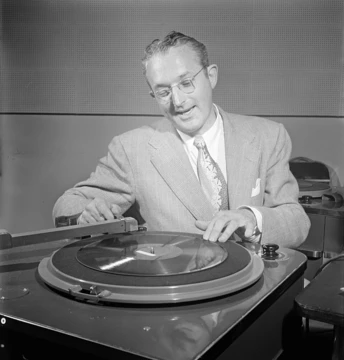
Dicky Wells
American jazz trombonist known for his work with Count Basie.
Last updated

via Wikipedia: Dicky Wells · see source
William Wells, known professionally as Dicky Wells (sometimes Dickie Wells), was an American jazz trombonist. He was born in Centerville, Tennessee on June 10, 1907 or 1909, and died on November 12, 1985. Wells is best remembered for his eleven-year tenure with Count Basie's band and his distinctive, speech-like trombone style.
Early life
Wells was born in Centerville, Tennessee to farmer George Washington Wells and Florence. He had a brother, Charlie or Henry, and three sisters: Leona, Tenny, and Georgia.
The family moved to Nashville for a time, then to Louisville, Kentucky when Wells was ten, after his stepfather Felix Murray moved them. His mother traveled with his stepfather, so sister Leona cared for him and his brother. Both parents died within a year of each other, which took its toll on him.
Early career
In Louisville, Wells played in a band sponsored by the Booker T. Washington Community Center, with Jonah Jones, Bill Beason, Buddy Lee, and Helen Humes. Instruments were provided by Miss Bessie Allen, conducted by Lockwood Lewis, and they traveled by truck to county fairs. Wells started on baritone horn but switched to trombone after breaking the only baritone horn. The band shrank to a seven-piece jazz group playing funerals, parades, and parties around Kentucky.
His first paid job was with Lucius Brown at the Eight Mile House until a train wreck—an oil truck collided with the train, causing an explosion; the band was injured but had no casualties. After a performance at Lyon's Garden, Lloyd Scott convinced him to join the Bright Boys in Springfield. They lived at the Sterling Hotel in Cincinnati, then went to New York after Buchanan of the Savory Ballroom heard them in Pittsburgh. Wells later played with Benny Carter, Spike Hughes, and Fletcher Henderson, replacing J.C. Higginbotham in Henderson's band.
He interacted with Coleman Hawkins and Henry "Red" Allen. He toured with Teddy Hill in Paris, where critic Hugues Panassié recruited him to play with Django Reinhardt and Bill Coleman, resulting in two successful recorded sessions under his name.
Basie years
In 1938, Herschel Evans and Lester Young saw Wells's work with Hill and invited him to Count Basie's house. He played with the band at a country club in Plainfield, New Jersey, then was hired for a six-week show at the Famous Door, which extended to three months.
Basie asked him to stay, and Wells agreed. He remained with Basie for eleven years total: 1938–1945 and 1947–1950, leaving temporarily due to tonsil and stomach disorders. During his break he worked with Lucky Millinder and J. C. Heard.
Late career
Wells returned to Europe in 1953, playing with Coleman and Zutty Singleton. There he realized his drinking habits and began reducing consumption. He toured with Buck Clayton in Paris, London, Italy, Sweden, and Denmark. In October 1961 he made his first appearance with Ray Charles's band, touring for three months before leaving due to health conditions.
He later played with B. B. King's band at the Apollo Theatre in Harlem. In later years, a severe mugging affected his memory, but he recovered and performed frequently at the West End jazz club with The Countsmen, led by Earle Warren. Wells made his own "pepper pot" mute.
More in Swing Trombonists
Sources
Compiled from Wikipedia and the sources listed below. Text from Wikipedia is available under CC BY-SA 4.0; this entry is adapted from it.
- Wikipedia: Dicky Wells (CC BY-SA 4.0).
Spotted an error? Know more?
Reader corrections go straight into our review queue. Suggest an edit · How this site is sourced