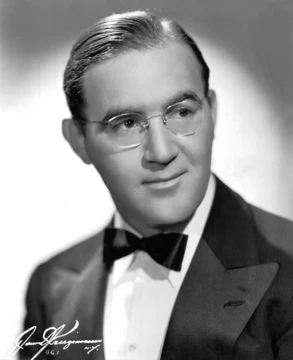
Artie Shaw
Clarinetist and bandleader known for "Begin the Beguine."
Last updated

via Wikipedia: Artie Shaw · see source
Artie Shaw was an American clarinetist, composer, bandleader, and author of both fiction and nonfiction. He led one of the United States' most popular big bands from the late 1930s through the early 1940s and is widely regarded as one of jazz's finest clarinetists. His 1938 recording of Cole Porter's "Begin the Beguine" became a defining record of the era, propelling him from obscurity to major pop artist status.
Early life
Arthur Jacob Arshawsky was born on May 23, 1910 in New York City. His mother Sarah (née Strauss) and father Harold "Harry" Arshawsky, a dressmaker and photographer, were Jewish; his father came from Russia, his mother from Austria.
He grew up in New Haven, Connecticut, where local antisemitism deepened his natural introversion. At 13 he bought a saxophone by working in a grocery store and began learning to play it. At 16 he switched to the clarinet and left home to tour with a band.
Career
Returning to New York, Shaw became a session musician through the early 1930s. From 1925 to 1936 he performed with many bands and orchestras; from 1926 to 1929 he worked in Cleveland, establishing a lasting reputation as music director and arranger for violinist Austin Wylie's orchestra. In 1929 and 1930 he played with Irving Aaronson's Commanders, where he was exposed to symphonic music. In 1932 he joined the Roger Wolfe Kahn Orchestra and recorded "It Don't Mean a Thing (If It Ain't Got That Swing)" and "Fit as a Fiddle."
Bandleader
He first gained attention in 1935 with "Interlude in B-flat" at a swing concert at the Imperial Theater in New York. During the swing era, his big bands were popular with hits like "Begin the Beguine" (1938), "Stardust" (with a trumpet solo by Billy Butterfield), "Back Bay Shuffle," "Moonglow," "Rosalie," and "Frenesi." The band was forced to dissolve in 1937 because its sound was not commercial; Shaw valued experimental and innovative music over dancing and love songs.
He used unusual instrumentation; "Interlude in B-flat" was backed with only a rhythm section and a string quartet, one of the earliest examples of what would later be called Third Stream music. In 1938 he hired Billie Holiday as his band's vocalist, becoming the first white bandleader to hire a full-time black female singer to tour the segregated Southern U.S. After recording "Any Old Time," Holiday left due to hostility from audiences in the South and from music company executives who wanted a more "mainstream" singer.
In 1940 he formed Artie Shaw and the Gramercy Five, named after his home telephone exchange, with pianist Johnny Guarnieri playing harpsichord and Al Hendrickson on electric guitar. The Gramercy Five's biggest hit was "Summit Ridge Drive," one of Shaw's million-selling records. His last prewar band, organized in September 1941, included Oran "Hot Lips" Page, Max Kaminsky, Georgie Auld, Dave Tough, Jack Jenney, Ray Conniff, and Guarnieri. Throughout his career, Shaw had a habit of forming bands, developing them according to his immediate aspirations, making a quick series of records, and then disbanding.
Following the breakup of his second band in 1939, he rarely toured, usually limiting personal appearances to long-term engagements in a single venue. He served in the U.S. Navy from 1942 to 1944, leading a morale-building band that toured the South Pacific. After his discharge in 1944, he returned to lead a band through 1945, then gradually withdrew from professional music, retiring completely in 1954.
Personal life
It only mentions that he was born to Jewish parents, grew up in New Haven, and experienced antisemitism.
Awards and honors
In 1938, DownBeat readers chose Artie Shaw’s band as the top swing ensemble. His admirers called him the “King of the Clarinet,” but Shaw thought the nickname should go to Benny Goodman, remarking, “Benny Goodman played clarinet. I played music.” Duke Ellington’s longtime clarinetist Barney Bigard named Shaw his favorite. Shaw earned a Grammy Lifetime Achievement Award in 2004.
Did You Know?
- He was an early proponent of what later became known as Third Stream music, blending classical and jazz forms, as heard in his 1935 "Interlude in B-flat" backed by only a rhythm section and a string quartet.
- Shaw used the morose "Nightmare" as his theme song, with Hasidic nuances, rather than a more accessible tune.
More in Swing Clarinetists
Test yourself
Three questions drawn from this entry’s sources. Pick an answer to check it.
Answers checked against the source article
Sources
Compiled from Wikipedia and the sources listed below. Text from Wikipedia is available under CC BY-SA 4.0; this entry is adapted from it.
- Wikipedia: Artie Shaw (CC BY-SA 4.0).
Spotted an error? Know more?
Reader corrections go straight into our review queue. Suggest an edit · How this site is sourced