Frequently Asked Questions
The most-asked questions about swan maidens.
What exactly is a 'swan maiden' story?
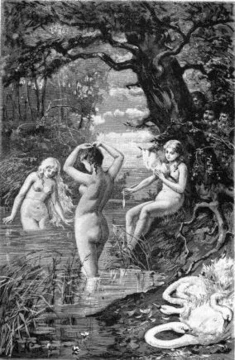
A swan maiden tale is a folk narrative in which a supernatural woman who can transform into a swan is discovered by a human while in her bird form. The human typically conceals her swan-feathered skin or cloak, compelling her to remain in human shape and often to enter a marriage or domestic arrangement with him.
Who are the central characters in the story?
The swan maiden is the protagonist, a celestial or water-dwelling woman who alternates between human and swan form. The human discoverer—often a young man, shepherd, or fisherman—is the second key figure, and many variants add a rival suitor, a king, or a sorcerer as an antagonist.
In which cultures does the tale appear?
The motif is remarkably widespread, with documented versions in Greek, Slavic, Persian, Turkish, Mongolian, Chinese, Japanese, and numerous other European and Central Asian traditions. It is one of the most geographically distributed motifs in comparative folklore.
What is the standard plot arc?
A human finds the maiden bathing, hides her feathered garment, and she is forced to stay and often marry him. After a period of domestic life that may include children, she recovers her feathers, flies away, and returns to the sky—either carrying her offspring with her or leaving them gazing upward in longing.
How is the tale classified in folklore scholarship?
Folklorists index the swan maiden under Aarne-Thompson-Uther type 400, 'The Bird-Betrothed,' which groups all variants where a human wins a bird-shape woman by seizing her feathered skin. This distinguishes it from related but separate motifs such as the crane-wife or goose-maiden tales, though the underlying structural logic is similar.
What are the recurring themes?
The stories consistently explore the tension between wild freedom and domestic captivity, the violation of a supernatural being's autonomy, and the bittersweet cost of crossing between the human and the celestial realms. Loss, longing, and the impossibility of fully possessing another being's nature serve as emotional through-lines.
Why is the stolen feather-cloak such a central device?
The cloak or skin is the maiden's literal means of transformation, so removing it constitutes an act of magical binding that strips her of agency. It also creates the tale's central dramatic question—whether she can ever recover it—and provides a concrete, visual symbol of captivity.
How does it differ from 'Tsuru no Ongaeshi' (The Crane's Return of a Favor)?
While both involve a bird-woman in a domestic setting, the crane-wife tale emphasizes gratitude, self-sacrifice, and the breaking of a taboo when the husband watches her, whereas the swan maiden centers on forced captivity through a stolen garment. The crane story is a specifically Japanese narrative; the swan maiden is a pan-cultural motif.
What are some notable written or adapted versions?
The motif appears in classical Greek sources, in Slavic and Persian folk-tale collections, and in modern retellings across literature, animation, and film. It has been adapted into children's books, anime, stage plays, and video games, making it one of the most frequently reimagined fairy-tale structures in popular media.
Where should a newcomer start reading?
A good entry point is any comparative-folklore anthology that includes ATU 400, or a regional collection (such as Slavic, Greek, or Persian tale compilations) to appreciate the local flavor. For a more accessible introduction, modern retellings and illustrated children's books on the swan maiden tend to distill the core plot without requiring prior folklore knowledge.