King Kojata
Russian fairy tale protagonist bound by a rash promise.
Last updated
King Kojata is a figure from a Russian fairy tale collected by Alexander Afanasyev, also known as 'The Unlooked for Prince' or 'Prince Unexpected'. The tale is classified as ATU 313, 'The Magic Flight', and involves a rash promise, a magical helper, and the motif of the forgotten fiancée.
Last updated 2026-09-28 from the source article.
Quick Facts
- Nationality
- Russian (Slavonic)
Facts from the source article.
Lore & Background
The tale begins with a childless king who, while hunting, becomes thirsty and finds a well with a floating cup. Unable to grasp the cup, he drinks directly and is seized by a creature (Koschei in Russian) who demands a promise: the most precious thing in his palace not there when he left (Polish) or something he knew nothing about (Russian). The king promises, and upon returning home finds his wife has borne a son, the prince. When the prince grows up, an old man tells him to remind his father of the bargain; the prince then sets out to fulfill it.
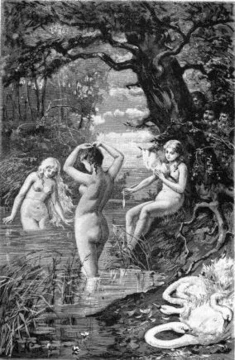
On his journey, the prince encounters a lake where thirty ducks (Russian) or twelve geese (Polish) swim, with clothes on the shore. He takes one set of clothes, and a bird (the youngest daughter of the creature) begs for its return. She becomes a woman, thanks him, and advises him how to approach her father.
The father sets three tasks: build a marble palace in a day, identify the youngest daughter among her sisters (marked by a ladybug or fly), and make a pair of boots. With the maiden's help, the first two tasks succeed; for the third, they flee. The maiden uses spittle or frost to delay pursuit, and they transform into a river and bridge, then a forest, then a church and priest, escaping the father.
In longer variants, the prince later kisses a child and forgets the maiden. She becomes a flower, then is revealed by an old man, and eventually attends the prince's wedding feast. She makes a wedding cake from which two doves emerge; one dove reproaches the other for abandoning its mate, reminding the prince of his forgotten bride. He remembers, finds her, and they ride to his father's kingdom.
Reader's Guide
The tale 'King Kojata' is significant as a representative of the widespread ATU 313 tale type, 'The Magic Flight', with the 'Forgotten Fiancée' episode (type 313C). It illustrates the 'rash promise' motif and the swan maiden narrative, where enchanted princesses transform into birds. The story has been collected in multiple variants across Slavic cultures, including Polish, Russian, and Czech versions, and was translated by Andrew Lang, A. H. Wratislaw, and others.
Its inclusion in Lang's 'The Green Fairy Book' and other compilations helped introduce it to a wider audience. The antagonist is sometimes identified with Koschei the Deathless, a figure from Russian folklore. The tale's structure—a hero aided by a magical helper, performing impossible tasks, and escaping through transformations—has parallels in many European folktales and remains a classic example of the genre.
Folkloristic Scope and the Magic Wife Framework
The swan maiden tale, classified as ATU 400, sits within a much broader folkloristic landscape. While the name suggests a specific avian identity, the supernatural wife in these narratives can be a swan, goose, crane, duck, heron, dove, vulture, or parrot, and in some tellings she is a star, a celestial nymph, or a lake fairy. Russian folklorist Eleazar M. Meletinskii studied the human-animal marriage tradition extensively, though he cautioned that subsuming all such tales under the swan maiden label excessively broadens the topic.
The swan maiden motif is a specific instance of the far more widespread Magic Wife motif, which scholars regard as one of the most widely distributed narrative elements in the world, likely many millennia old. It is also among the most interconnected motifs, serving as a central reference point for numerous other story types. The Enzyklopädie des Märchens sometimes restricts discussion to cases where the wife is specifically a swan, goose, or other bird, but the broader ATU 400 classification encompasses a far wider spectrum of supernatural beings and transformation mechanisms.
More in Swan maidens
Sources
Compiled from Wikipedia and the sources listed below. Text from Wikipedia is available under CC BY-SA 4.0; this entry is adapted from it.
- Wikipedia: King Kojata (CC BY-SA 4.0).
Spotted an error? Know more?
Reader corrections go straight into our review queue. Suggest an edit · How this site is sourced