Frequently Asked Questions
The most-asked questions about supernova remnants.
What exactly is a supernova remnant?
A supernova remnant is the expanding shell of ionized gas, dust, and high-energy radiation left behind after a massive star explodes or a white dwarf detonates, scattering its material into the surrounding interstellar medium. Over thousands of years the shell cools, thins, and eventually fades until it is indistinguishable from the galactic background.
Who are the 'main characters' every fan should know?
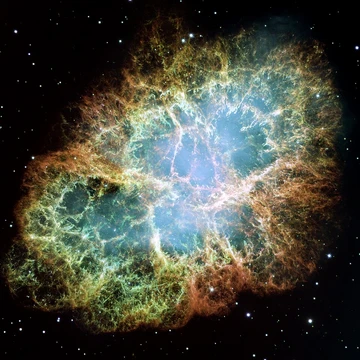
The most iconic remnants include the Crab Nebula (M1), Cassiopeia A, Tycho's SNR, Kepler's SNR, and the Vela SNR, each representing a different stage or type of stellar death. The Crab and Cassiopeia A are usually treated as the flagship entries because they are bright, heavily studied, and visually striking across multiple wavelengths.
Where should a newcomer start their journey into supernova remnants?
The Crab Nebula is the natural first stop: it is the brightest and most famous, tied to a well-documented 1054 CE explosion, and visible even in modest telescopes. From there, fans typically branch out to Cassiopeia A for a younger, more energetic example or to Tycho and Kepler for historically recorded events.
How long does a supernova remnant 'live' before it disappears?
Most remnants remain detectable for roughly 10,000 to 30,000 years before their shock waves slow enough and the gas cools to the point where it blends into the surrounding medium. The oldest known remnants, such as W44 and IC 443, are pushing toward the upper end of that window.
What's the difference between a Type Ia and a core-collapse remnant?
A Type Ia remnant (like Tycho or Kepler) forms when a white dwarf in a binary system exceeds its mass limit and detonates, leaving no neutron star behind. A core-collapse remnant (like the Crab or Cassiopeia A) results from a massive star's iron core collapsing inward, often producing a rapidly spinning pulsar at the center.
What are the most 'notable moments' in the history of SNR observation?
The 1054 CE Chinese and Japanese records of a 'guest star' that became the Crab Nebula are the oldest well-documented event. Tycho's 1572 and Kepler's 1604 supernovae shattered the medieval belief in an unchanging heavens, and the 1967 discovery of the Crab pulsar confirmed the neutron-star link to core-collapse remnants.
How many supernova remnants do we actually know about?
Roughly 300 remnants are catalogued within the Milky Way, with another 30 or so identified in nearby galaxies such as the Magellanic Clouds. Because many older remnants fade below detection thresholds, astronomers estimate the true historical count could be several times higher.
Can you actually see a supernova remnant with the naked eye or a backyard telescope?
The Crab Nebula is the only remnant visible to the unaided eye under truly dark skies (magnitude about 6), and it is a common target for six-inch or larger telescopes. Most others require binoculars, larger scopes, or — for the faintest — radio and X-ray observatories, since their emission peaks outside the visible spectrum.
What do supernova remnants do for the galaxy they live in?
They inject heavy elements forged in the star's core into the interstellar medium, seed future generations of stars and planets, and their shock waves can compress nearby molecular clouds to trigger new star formation. In that sense every remnant is both an ending and a construction site.
Why do some remnants have a glowing 'pulsar wind nebula' at their center while others don't?
A pulsar wind nebula appears when the central neutron star is still young and spinning fast, blasting out a relativistic particle wind that inflates a bright bubble inside the outer shell. Older remnants whose pulsars have spun down, or Type Ia remnants with no neutron star at all, lack this inner glow.