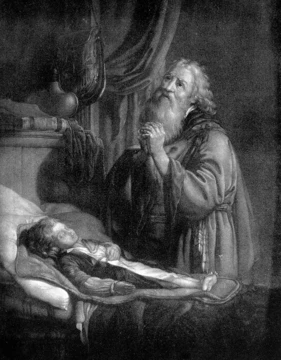
Efficacy of prayer
Prayer's health effects remain debated and scientifically inconclusive.
Scientists have been testing whether prayer can measurably improve someone's health since at least 1872. Studies on people praying for themselves sometimes show benefits like better heart function or mood, but these findings are mixed and often rely on what participants report. Research on praying for others has yielded inconsistent results, with the most careful large-scale trials typically finding no clear effect.
Quick Facts
- Earliest study year
- 1872
- Largest study
- 2006 STEP project
- Annual global research spending
- $5 million
- Study population (bernardi)
- cardiovascular patients
Facts from the source article.
Studies of intercessory prayer
Research confirms that people who pray are themselves impacted by the act, with measurable physical changes. For instance, a 2001 study found that cardiovascular patients who prayed the rosary or chanted yoga mantras at a steady rhythm showed a notable increase in baroreflex sensitivity. In 2008, researchers used Eysenck's personality model to examine mental health in high school students based on how often they prayed. Among both Catholic and Protestant students, more frequent prayer correlated with lower psychoticism scores, indicating better mental health. However, Catholic students who prayed more also scored higher on neuroticism. Knowing that others are praying for someone can also lift that person's spirits and improve morale, which may help recovery—a phenomenon tied to the subject-expectancy effect. Studies indicate that prayer can lower psychological stress, regardless of which deity is addressed, aligning with several possible explanations for this benefit. According to one healthcare system study, the psychological advantages of prayer may include reduced stress and anxiety, a more positive outlook, and a stronger will to live. Similar practices like yoga, tai chi, and meditation can also positively affect physical and mental health. A 2001 survey of 1,421 Presbyterian pastors found that those who prayed more frequently also rated their own health and vitality higher. But the researchers acknowledged that this kind of correlational study has built-in limitations, such as self-selection and selection bias, making it impossible to determine whether prayer leads to better health or healthier people simply pray more. Controlled experiments on prayer's effectiveness date back to at least 1872, when Francis Galton initiated a long-running debate. Despite this history, well-monitored prayer studies are rare, with only about $5 million spent globally each year on such research. The largest trial, the 2006 STEP project, found no meaningful difference in recovery rates for heart surgery patients who were prayed for compared to those who were not.
Belief and skepticism
The scientific community largely dismisses practitioners of faith healing. Those who believe in it argue that faith healing does not make scientific claims, so it should be considered a matter of faith beyond scientific testing. Critics counter that any assertion of a medical cure must be tested scientifically; while supernatural faith itself is not usually science’s domain, claims of repeatable effects are open to investigation. Scientists and doctors generally see faith healing as lacking biological plausibility and epistemic warrant—a key factor in deciding whether clinical research is ethical and worth funding. A Cochrane review on intercessory prayer found that most individual studies did not show a positive effect, though a few did. The reviewers concluded they were not convinced further trials should be done, preferring to use resources for other health care questions. An article in the Medical Journal of Australia notes a common criticism: prayer has become a popular therapy with no known plausible mechanism. Medical professionals remain skeptical of study claims until they are reproduced and confirmed. Despite conflicting results across studies, physicians continue to research prayer, partly because patients increasingly use it as a coping tool. In a Newsweek debate, atheist Sam Harris pointed out that most people’s personal impressions of prayer’s effectiveness stem from sampling error, since humans have a poor sense of probability and tend to notice confirmations of their faith while overlooking disconfirmations.
Religious and philosophical issues
Not everyone agrees that the effectiveness of prayer should even be studied. Some point to a biblical passage, Deuteronomy 6:16, which warns against testing God, as a reason why prayer cannot or must not be examined. From a religious perspective, the idea that prayer can be subjected to experiments or statistical analysis is rejected. Critics argue that assumptions in such studies, like the notion that a thousand prayers are statistically different from a single one, are flawed. They also note that religion deals with unique, uncontrollable events, while science and statistics focus on recurring phenomena that can be sampled, controlled, and governed by general laws. Another objection is that once prayer is measured and placed inside an experiment, it stops being genuine prayer; the very act of studying it shows a misunderstanding of what prayer is for. In the 2006 STEP experiment, some participants complained that the scripted prayers they were required to use did not reflect how they normally pray. Regarding the idea of expecting a response, the 18th-century philosopher William Paley wrote that asking for specific favors presumes to dictate to Divine Wisdom and is presumptuous, and that interceding for others or nations assumes their happiness depends on our choices. In the 20th century, Bertrand Russell argued that religion and science have long been in conflict over the same territory, ideas, and loyalties, and that science had decisively won that war. Nearly forty years earlier, when Russell was 22, he wrote that although he had long stopped believing prayer worked, he was so lonely and in need of a supporter like the Christian God that he began praying again, even after he had ceased to believe in its effectiveness.
More in Supernatural Healing
Spotted an error? Know more?
Reader corrections go straight into our review queue. Suggest an edit · How this site is sourced