
Blue Origin NS-25
First human New Shepard flight since 2022 grounding.

Space.tracker.nerd · CC BY 4.0
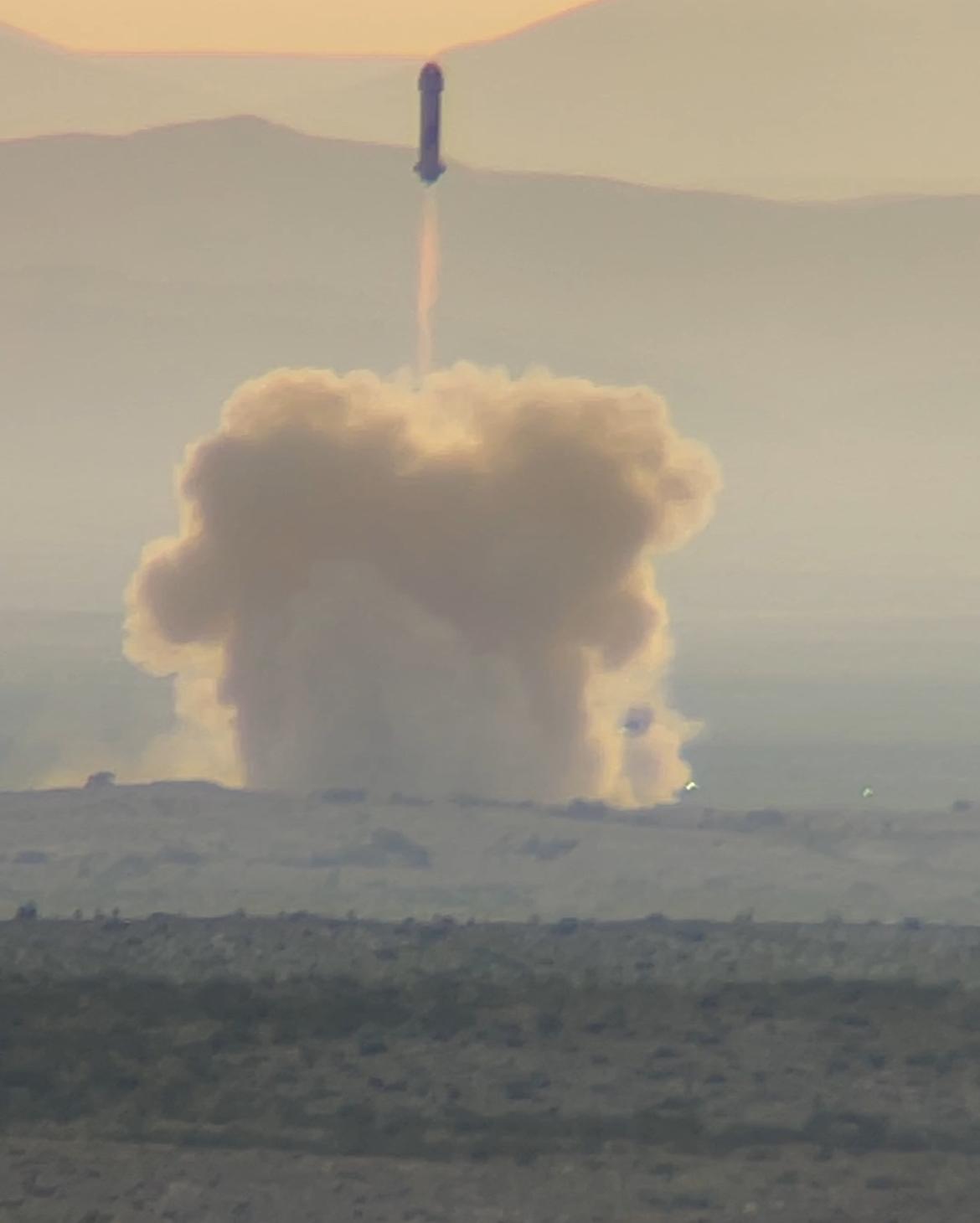
Blue Origin’s NS-25 mission launched on May 19, 2024, aboard a New Shepard rocket, carrying six people on a sub-orbital flight. It marked the first crewed New Shepard flight since NS-22 in August 2022; the fleet had been grounded after an engine failure on an uncrewed cargo mission in September 2022, and resumed flights in December 2023. The capsule reached a peak altitude of 107 kilometers (66 miles). Passengers felt weightless at 3 minutes and 12 seconds into the flight, and the capsule crossed the Kármán line at 3 minutes and 31 seconds. The booster touched down seven minutes after launch, while the capsule—using only two of its three parachutes—landed ten minutes after liftoff. Launch commentators noted the capsule is designed to land safely with two parachutes.
Among the passengers, Ed Dwight, often called the first African-American astronaut candidate, had reached the second round of a 1961 Air Force program from which NASA selected astronauts but was not chosen. At age 90 years, 253 days, he became the oldest person to reach space at that time, surpassing William Shatner's record set on NS-18 (October 13, 2021) at age 90 years, 205 days. Gopichand Thotakura, a graduate of Embry–Riddle Aeronautical University who founded a pilot training program and an air ambulance service, became the second Indian-born person to go to space and the first Indian on a sub-orbital tourist flight; he used the mission to advocate for more female pilot schools in India. Mason Angel, a venture capitalist whose firm Industrious Ventures invests in commercial and national security space startups, serves on the boards of Space For Humanity, Stoke Space, Xona Space, and Lunar Outpost. Sylvain Chiron, founder of the French brewery Brasserie du Mont-Blanc, had tried to become an astronaut at age 16 before becoming a French Air Force pilot.
Quick Facts
- Mission Type
- Sub-orbital human spaceflight
- Suborbital Apogee
- 107 km
- Spacecraft
- RSS First Step
- Manufacturer
- Blue Origin
- Crew Size
- 6
- Crew Members
- Mason Angel · Sylvain Chiron · Ed Dwight · Kenneth Hess · Carol Schaller · Gopichand Thotakura
- Launch Rocket
- New Shepard (NS4)
- Launch Site
- Corn Ranch, LS-1
- Landing Site
- Corn Ranch
- Insignia Caption
- Blue Origin NS-25 mission patch
Facts from the source article.
Lore & Background
NS-25 carried six passengers, including Ed Dwight, often cited as the first African-American astronaut candidate. Dwight had made it to the second round of a 1961 Air Force program from which NASA selected astronauts, but was not selected. At age 90 years, 253 days, he became the oldest person to reach space at that time, surpassing William Shatner's record set on NS-18 (October 13, 2021) at age 90 years, 205 days. Gopichand Thotakura became the second Indian-born person to go to space and the first to do so on a suborbital mission and as a tourist. A graduate of Embry–Riddle Aeronautical University, he founded a pilot training program and an air ambulance service, using his flight to advocate for more female pilot schools in India.
Reader's Guide
Blue Origin NS-25 marked the resumption of human spaceflight for Blue Origin after a nearly two-year hiatus caused by a September 2022 engine failure on an uncrewed cargo mission. The flight demonstrated the New Shepard system's return to operational status, with the booster landing seven minutes after launch and the capsule touching down ten minutes after liftoff, despite deploying only two of its three parachutes—a scenario launch commentators assured was within design safety margins. The mission's passenger manifest highlighted diverse backgrounds: Ed Dwight, a pioneering African-American astronaut candidate from the 1960s, set a record as the oldest person to reach space; Gopichand Thotakura became the first Indian suborbital tourist; Mason Angel, a venture capitalist, invested in space startups; and Sylvain Chiron, a French brewer and former Air Force pilot, fulfilled a childhood ambition. The flight underscored the growing accessibility of suborbital space travel for tourism and advocacy.
Did You Know?
- Ed Dwight, at age 90 years, 253 days, became the oldest person to reach space at that time on NS-25, surpassing William Shatner's record of 90 years, 205 days set on NS-18.
- The capsule deployed only two of its three parachutes during landing, which launch commentators said was within safe design parameters.
- NS-25 was the first human flight of New Shepard since NS-22 in August 2022, after a grounding due to a September 2022 engine failure.
Gallery
Frequently Asked Questions
What is Blue Origin NS-25?
NS-25 is a suborbital crewed spaceflight that Blue Origin flew on its New Shepard rocket on May 19, 2024. Six passengers rode in the capsule, which climbed to a peak altitude of 107 kilometers (66 miles) before returning to Earth.
Why was there a two-year gap between NS-22 and NS-25?
An engine failure during an uncrewed cargo test in September 2022 forced Blue Origin to ground the entire New Shepard fleet. The program ran uncrewed check flights starting in December 2023, and NS-25 was the first mission to put humans back in the capsule.
How long did the NS-25 flight last and what were the key moments?
The booster touched down about seven minutes after liftoff. Passengers began feeling weightless at roughly three minutes and twelve seconds, and the capsule crossed the 100-kilometer Kármán line at about three minutes and thirty-one seconds.
How many people flew on Blue Origin NS-25?
Six passengers were aboard the New Shepard capsule for the May 2024 flight. The mission was a standard suborbital profile rather than an orbital or cargo run.
Why do fans consider NS-25 a milestone for the New Shepard program?
It proved the fleet could safely return to carrying human beings after the 2022 grounding and subsequent inspections. The clean 107-kilometer profile and nominal landing confirmed Blue Origin had fully restored confidence in the vehicle for tourist flights.
More in Suborbital human spaceflights 1-24
Spotted an error? Know more?
Reader corrections go straight into our review queue. Suggest an edit · How this site is sourced