Frequently Asked Questions
The most-asked questions about submachine guns.
What exactly is a submachine gun?
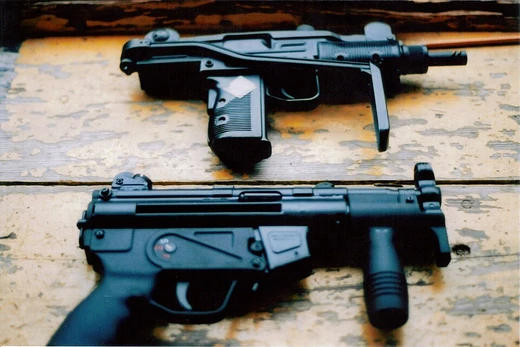
A submachine gun is a selective-fire, magazine-fed firearm chambered for a pistol-caliber cartridge and designed to be shouldered. It occupies the middle ground between a handgun and a rifle in size, weight, and intended engagement distance.
How does an SMG differ from an assault rifle?
The defining distinction is the cartridge: SMGs fire pistol rounds such as 9 mm or .45 ACP, whereas assault rifles fire intermediate rifle cartridges. In practice this makes SMGs lighter, shorter, and generally easier to control in full-auto fire at close range.
Who are the most influential figures in submachine gun design?
John T. Thompson is the most recognizable name, having brought the Thompson 'Tommy Gun' to worldwide attention in the 1920s and 1930s. In Europe, the design teams at Erma Werke (MP40) and later Heckler & Koch (MP5) shaped the two dominant lineages of the category.
Where should a newcomer start learning about submachine guns?
The Thompson M1921 and the German MP40 are the two foundational designs that established the SMG's role during World War II. From there, the Heckler & Koch MP5 represents the modern evolution and remains the most widely adopted SMG in military and police service worldwide.
What calibers are submachine guns typically chambered in?
9×19 mm Parabellum is by far the most common, appearing in the vast majority of modern designs. Other frequent choices include .45 ACP (the original Thompson), 7.65×17 mm Browning, and 5.7×28 mm for certain specialized compact models.
What makes the MP5 so iconic in the submachine gun world?
Introduced by Heckler & Koch in 1966, the MP5 popularized a roller-delayed blowback operating system that delivered notably better accuracy than earlier SMGs. It went on to become the default close-quarters weapon for SWAT teams, special-forces units, and police forces across dozens of countries.
What was the historical origin of the submachine gun category?
SMGs emerged during World War I as a response to the close-quarters chaos of trench warfare, where infantry needed a compact, high-rate-of-fire weapon. The Bergmann MP18 of 1918 is generally regarded as the first true submachine gun, followed quickly by the Luger-based MP9 and the Thompson.
What key mechanical features define a submachine gun?
By convention, an SMG is a selective-fire weapon fed by a detachable box magazine, intended to be shouldered, and chambered for a pistol cartridge. It is distinct from a machine pistol, which is typically operated one-handed and lacks a shoulder stock.
What are some notable moments in submachine gun history?
The Thompson's adoption by the U.S. military as the M1928A1 in 1940 cemented its status as a cultural icon of the era. The MP5's 1966 debut marked a shift toward precision and modularity, and the 1990s brought compact polymer-framed designs like the Uzi Pro and Beretta 96 that redefined the category for close-protection roles.
Are submachine guns still relevant in modern military and law-enforcement use?
Yes—while the line between SMGs and compact personal-defense weapons has blurred with models like the MP7 and P90, dedicated SMGs remain in service for their lower recoil, lighter weight, and reduced over-penetration in urban settings. They are still standard-issue for vehicle crews, special-operations teams, and close-quarters tactical units worldwide.