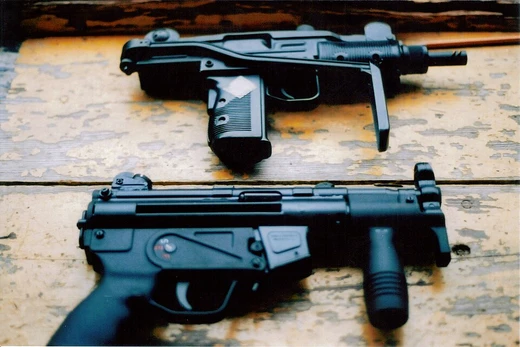
M50 Reising
Last updated
Over 100,000 Reisings were ordered during World War II for use by U.S. Navy, Marine Corps, Coast Guard, and allied forces.[1]
How it changed
The Reising was innovative for its time, offering similar firepower to the Thompson but with better accuracy, lighter weight (seven vs. eleven pounds), and much lower cost ($62 vs. $200).[2] Its closed-bolt, delayed blowback design gave it superior accuracy in semi-automatic and at the onset of automatic fire compared to open-bolt guns.[2][3] The U.S. Army tested the Reising in November 1941 and again in 1942, but did not adopt it due to initial part failures.[2] The Navy and Marines adopted the Reising because of insufficient supply of Thompsons.[2][4]
The Reising first saw combat on August 7, 1942, with the 1st Marine Division at Guadalcanal and with Marine Raiders on Tulagi and Tanambogo.[5] In late 1943, after numerous complaints about reliability in jungle conditions, the Reising was withdrawn from Fleet Marine Force units.[6]
What the maker and period sources say
The 1942 U.S. government manual for the Reising stated it was "capable of intensive fire against personnel within a range of 300 yards."[4] That manual attributed the weapon's accuracy to its better stock fit and intricate closed-bolt, delayed blowback design.[4] A 1941 article stated the Reising was intended for mass production and cost about $50 each, while the Thompson cost $225.[7]
References
- Wikipedia, "M50 Reising" (CC BY-SA 4.0), which cites: Robert C. Ankony, "The US .45 Model 50 and 55 Reising submachine gun and Model 60 Semiautomatic Rifle," Small Arms Review, Jul.2008.; Thomas B. Nelson, The World's Submachine Guns, TBN Enterprises, 1963 (original not read by us) en.wikipedia.org
- Wikipedia, "M50 Reising" (CC BY-SA 4.0), which cites: Robert C. Ankony, "The US .45 Model 50 and 55 Reising submachine gun and Model 60 Semiautomatic Rifle," Small Arms Review, Jul.2008. (original not read by us) en.wikipedia.org
- Wikipedia, "M50 Reising" (CC BY-SA 4.0), which cites: Robert C. Ankony, "The US .45 Model 50 and 55 Reising submachine gun and Model 60 Semiautomatic Rifle," Small Arms Review, Jul.2008.; Lt. Col. John George, Shots Fired in Anger, Samworth Press, 1948; Roy F. Dunlap, Ordnance Went Up Front, Samworth Press, 1948 (original not read by us) en.wikipedia.org
- Wikipedia, "M50 Reising" (CC BY-SA 4.0), which cites: S. Schmidt, Manual for the Reising Submachine Gun: Caliber .45 Models 50, 55, and 60, United States Government Printing Office, Washington, D.C. (1942): p.2 (original not read by us) en.wikipedia.org
- Wikipedia, "M50 Reising" (CC BY-SA 4.0), which cites: Thomas B. Nelson, The World's Submachine Guns, TBN Enterprises, 1963 (original not read by us) en.wikipedia.org
- Wikipedia, "M50 Reising" (CC BY-SA 4.0), which cites: p.515 Rottman, Gordon L. U.S. Marine Corps World War II Order of Battle 2003 Greenwood Publishing (original not read by us) en.wikipedia.org
- Wikipedia, "M50 Reising" (CC BY-SA 4.0), which cites: "Latest Submachine Gun Is Designed For Mass Production", April 1941, p. 73–76 (original not read by us) en.wikipedia.org
Each numbered sentence above was checked against the source it cites before publication. Sentences citing Wikipedia adapt text from the English Wikipedia article M50 Reising (contributors), used under CC BY-SA 4.0; this entry is available under the same licence. Other sources were used for facts only.
More in Submachine Guns
Sources
Compiled from Wikipedia and the sources listed below. Text from Wikipedia is available under CC BY-SA 4.0; this entry is adapted from it.
- Wikipedia: M50 Reising (CC BY-SA 4.0).
- Word definitions: the Codexery glossary, each quoted from its Wikipedia article.
Spotted an error? Know more?
Reader corrections go straight into our review queue. Suggest an edit · How this site is sourced