Frequently Asked Questions
The most-asked questions about submachine guns, part 2.
What exactly is a submachine gun?
A submachine gun is a compact, shoulder-fired automatic weapon that cycles pistol-caliber cartridges, designed primarily for close-quarters engagement. It occupies the middle ground between a handgun and a rifle in both size and ballistic output.
When did submachine guns first appear in warfare?
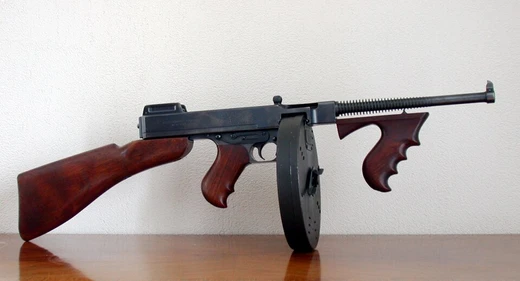
The earliest practical examples emerged during World War I, including the Italian Brevi and the American M1918 Thompson, both developed to give troops a more powerful automatic option than sidearms in trench combat. The interwar period saw rapid refinement of the concept across multiple nations.
What calibers are typical for submachine guns?
Most models chamber common pistol cartridges such as 9×19mm Luger, .45 ACP, or 7.62×25mm Tokarev. A smaller number of modern designs use intermediate rifle rounds, which has made the traditional definition of the category somewhat ambiguous.
How does a submachine gun differ from an assault rifle?
The core distinction is the cartridge: submachine guns fire pistol-caliber rounds, while assault rifles fire intermediate rifle cartridges with greater effective range and penetration. In practice, the line has blurred as many modern compact carbines fill a similar tactical role.
Which submachine guns are considered the most iconic?
The Thompson M1928, the German MP40, and the Israeli Uzi are widely cited as the defining designs of the twentieth century. The Heckler & Koch MP5 has also achieved near-universal recognition through decades of police and military adoption.
Why did the MP40 become so culturally significant?
Its widespread issue to German panzer and motorized infantry in World War II, combined with its distinctive stamped-steel body, made it a visual shorthand for the conflict. Decades of film, television, and video-game appearances have kept the MP40 firmly in the public imagination.
What role do submachine guns play in modern forces?
They remain popular among special-operations units, vehicle crews, and police tactical teams for close-quarters and personal-defense tasks. However, many armies have shifted toward compact carbines, reducing the number of dedicated SMG roles in standard loadouts.
What is a typical rate of fire for a submachine gun?
Most models cycle somewhere between 600 and 1,200 rounds per minute, with the Uzi sitting near the upper end of that range. This is generally slower than a full-sized assault rifle but faster than a semi-automatic pistol.
Can civilians legally own submachine guns?
In the United States, fully automatic models are classified as National Firearms, requiring a federal tax stamp, registration, and in many states additional prohibitions. Most other countries either ban civilian possession of full-auto weapons outright or restrict them to licensed collectors.
What are some notable modern submachine gun designs?
Examples include the Heckler & Koch MP7, the FN PS90, and the Kel-Tec C8, each taking a different approach to compact automatic firepower. These newer platforms tend to emphasize polymer construction, modular rail systems, and improved ergonomics over their predecessors.