Viroconium Cornoviorum
Roman city and former capital of the Cornovii tribe.
Last updated

via Wikipedia: Viroconium Cornoviorum · see source
Where it is
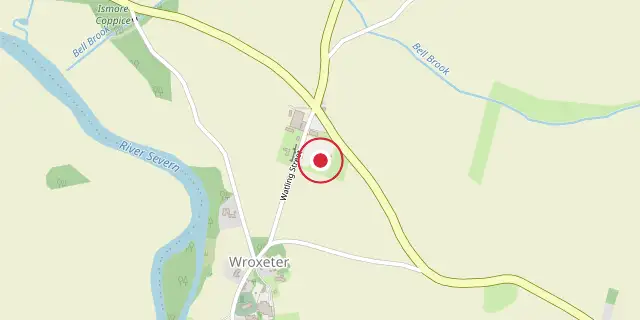
Coordinates: 52°40′26″N 2°38′38″W (52.6740, -2.6440) · Open in OpenStreetMap
Coordinates and connected clubs: the infobox of Wikipedia: Viroconium Cornoviorum (CC BY-SA 4.0). Map: drawn by Codexery from OpenStreetMap tiles.
Viroconium Cornoviorum, also called Viroconium or Uriconium, was a Roman city whose remains lie near the village of Wroxeter in Shropshire, England, about 5 miles east-south-east of Shrewsbury. At its peak it was the fourth-largest Roman settlement in Britain, with a population exceeding 15,000. The site, now cared for by English Heritage, includes a museum and a reconstructed Roman house.
History
Viroconium began as a frontier post for a cohort of Thracian Auxilia during the campaigns of governor Publius Ostorius Scapula in the early years of the Roman conquest. The site, near the end of Watling Street, defended the Severn valley and the route to the Wye valley. In the mid 1st century, Legio XIV Gemina replaced the auxilia with a larger legionary fortress in preparation for the invasion of Wales. In 78, governor Gnaeus Julius Agricola campaigned in North Wales and against druids on Ynys Môn; in 80 he took Legio XIV Gemina north to fight the Picts, and Legio XX Valeria Victrix took over the fortress.
By the late 80s, the army left after Legio XX moved to Deva Victrix (Chester), and the civilian settlement (canabae) began converting the fort into a town. An unfinished legionary bath house became the town's forum, and a civic street grid later replaced the fort's plan. A colonnaded forum was started in the 120s, covering the unfinished bath house, and a dedicatory inscription to Emperor Hadrian dates its completion to 130. At its peak, Viroconium was one of the richest and fourth-largest Roman settlements in Britain, with over 15,000 inhabitants, its wealth possibly due to access to Wales and trade routes.
Between 165 and 185 the forum burned down, along with neighbouring shops and houses, and was rebuilt with modifications.
Toponym
Viroconium is a Latinised form of a Common Brittonic toponym reconstructed as Uiroconion, meaning '[city] of Uirokū'. Uirokū, literally 'man-wolf', is believed to have been a masculine given name meaning 'werewolf'.
The original capital of the Cornovii was a hillfort on the Wrekin called Uiroconion; after their subjugation, the Romans moved the capital to Wroxeter and named it Viroconium. The addition 'Cornoviorum' distinguishes it as the Viroconium 'of the Cornovii'. The city is mentioned by Ptolemy, Suetonius, and other Roman historians.
Preservation
Some substantial remains of Viroconium survive, including 'the Old Work', an archway from the baths' frigidarium that is the largest free-standing Roman ruin in England, and parts of a baths complex. These are displayed to the public, along with a small museum, under the name 'Wroxeter Roman City', managed by English Heritage. Important finds are housed in the Music Hall Museum in Shrewsbury.
Most of the town remains buried but has been largely mapped through geophysical survey and aerial archaeology. Ongoing excavations continue; in 2024 a 2,000-year-old mosaic depicting dolphins and fish was uncovered. In February 2011 a reconstructed Roman villa opened to the public, built using authentic ancient techniques and featured in the television series Rome Wasn't Built in a Day.
More in Sub-Roman Britain
Sources
Compiled from Wikipedia and the sources listed below. Text from Wikipedia is available under CC BY-SA 4.0; this entry is adapted from it.
- Wikipedia: Viroconium Cornoviorum (CC BY-SA 4.0).
Spotted an error? Know more?
Reader corrections go straight into our review queue. Suggest an edit · How this site is sourced