Conrad discontinuity
Seismic boundary in continental crust between upper and lower layers.
Last updated
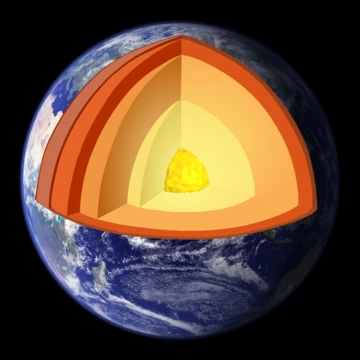
The Conrad discontinuity is a sub-horizontal boundary in the continental crust where seismic wave velocity increases discontinuously. It is observed at depths of 15 to 20 km in various continental regions but is absent in oceanic areas. Named after seismologist Victor Conrad, it was historically considered the contact between the upper sial (silica-aluminium) crust and the lower sima (silica-magnesium) crust, forming a basis for Alfred Wegener's continental drift theory. Its exact geological significance remains unclear, with some evidence suggesting it may represent a metamorphic transition.
Quick Facts
- Named after
- Victor Conrad
- Depth range
- 15 to 20 km / 12.4 mi
- Historical interpretation
- Boundary between sial and sima crustal layers
- Associated theory
- Alfred Wegener's Continental Drift Theory
Facts from the source article.
More in Structure of the Earth
Sources
Compiled from Wikipedia and the sources listed below. Text from Wikipedia is available under CC BY-SA 4.0; this entry is adapted from it.
- Wikipedia: Conrad discontinuity (CC BY-SA 4.0).
Spotted an error? Know more?
Reader corrections go straight into our review queue. Suggest an edit · How this site is sourced