Frequently Asked Questions
The most-asked questions about stony corals.
What exactly are stony corals?
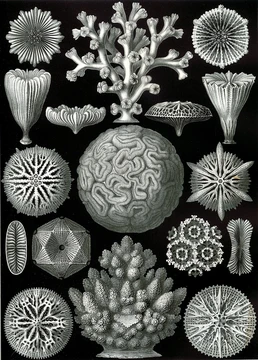
Stony corals (order Scleractinia) are marine invertebrates whose individual polyps secrete hard calcium carbonate skeletons, collectively building the structural backbone of tropical reefs. Over time, generations of polyps add tiny aragonite cups that accrete into massive reef frameworks visible from space.
How do stony corals differ from soft corals?
The defining difference is the skeleton: stony corals deposit a rigid, fused calcareous framework, while soft corals (Alcyonacea) have flexible bodies reinforced only by scattered microscopic spicules. On a dive or in a reef tank, stony corals appear as solid rock-like structures, whereas soft corals sway and bend with the current.
Who are the foundational figures in coral science?
Early Scleractinia taxonomy was shaped by naturalists such as Philippe Lesson, and later by James Duggan, whose 1980s monographs catalogued hundreds of reef-building species. In the modern era, researchers like Terry Hughes (Great Barrier Reef monitoring) and Peter Falkowski (symbiosis physiology) have become central names in the coral community.
Where should a newcomer start learning about stony corals?
Begin with the three major growth forms—branching (e.g., Acropora), massive (e.g., Porites), and plate (e.g., Pavona)—because morphology is how most species are first distinguished in the field. Once that visual vocabulary is in place, exploring the zooxanthellae symbiosis and the coral life cycle gives you the biological foundation everything else builds on.
What is a coral polyp, really?
A polyp is a single, roughly cylindrical animal with a central mouth ringed by stinging tentacles and a gastrovascular cavity for digestion. In stony corals each polyp sits in its own calcified cup (corallite), and hundreds to millions of them can form one visible colony.
What causes coral bleaching?
Bleaching happens when sustained thermal or light stress triggers the polyp to expel or lose its symbiotic zooxanthellae algae, leaving the white skeleton visible through the now-translucent tissue. It is a stress response rather than an instant kill, but if the algae do not recolonize, the colony starves and dies.
How do stony corals reproduce?
Most species reproduce sexually by broadcast spawning, releasing clouds of eggs and sperm into the water column at tightly timed windows often tied to lunar or seasonal cues. Many also grow asexually through fragmentation or polyp budding, which is how a single colony can spread across a reef over decades.
How old can a stony coral colony get?
Massive corals such as Porites and certain Montastraea species have been radiometrically dated to well over 9,000 years, making them among the oldest continuously living organisms on the planet. Even fast-growing branching corals like Acropora can persist for several decades before storms or disease finally break them apart.
Which families should I focus on first?
The three most species-rich and reef-building families are Acroporidae (branching and table corals), Poritidae (massive boulder corals), and Faviidae (including Montastraea and Favia). Familiarity with these three groups covers the bulk of the structural diversity you will see on any tropical reef.
Why are stony corals under threat right now?
Rising sea-surface temperatures, ocean acidification, and local stressors like sedimentation and disease are driving mass bleaching and slowing skeleton growth worldwide. The back-to-back 2016 and 2020 Great Barrier Reef bleaching episodes became landmark moments that sharpened global conservation focus on reef ecosystems.