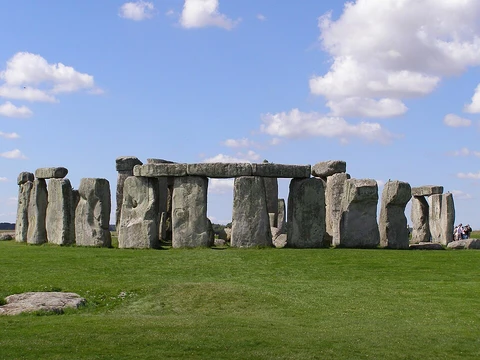
Laser scanning at Stonehenge
Laser scanning revealed new carvings and recorded Stonehenge in sub-millimetre detail.
Laser scanning at Stonehenge began in 2002 with a survey of Bronze Age carvings on stone 53, a sarsen trilithon. A team from Wessex Archaeology and Archaeoptics used a Minolta Vivid 900 scanner to record the dagger and axes at 0.5mm resolution, producing a point cloud later processed into a 3D model. The work revealed two previously unknown flanged axes, one with two lugs along its shaft. In 2011 English Heritage commissioned a full high-resolution scan of all visible stone faces and a lower-resolution scan of the ground in the Stonehenge Triangle.
Quick Facts
- First laser scan subject
- Bronze Age dagger and axes on stone 53
- Scanner used
- Minolta Vivid 900
- Scan resolution
- 0.5 mm / 0.02 in
- Year of first scan
- 2002
- Organizations involved
- Wessex Archaeology and Archaeoptics
Facts from the source article.
More in Stonehenge
Spotted an error? Know more?
Reader corrections go straight into our review queue. Suggest an edit · How this site is sourced